Bajaj Pulsar 125 vs TVS Raider: Which 125cc Bike Wins in India?
Overview
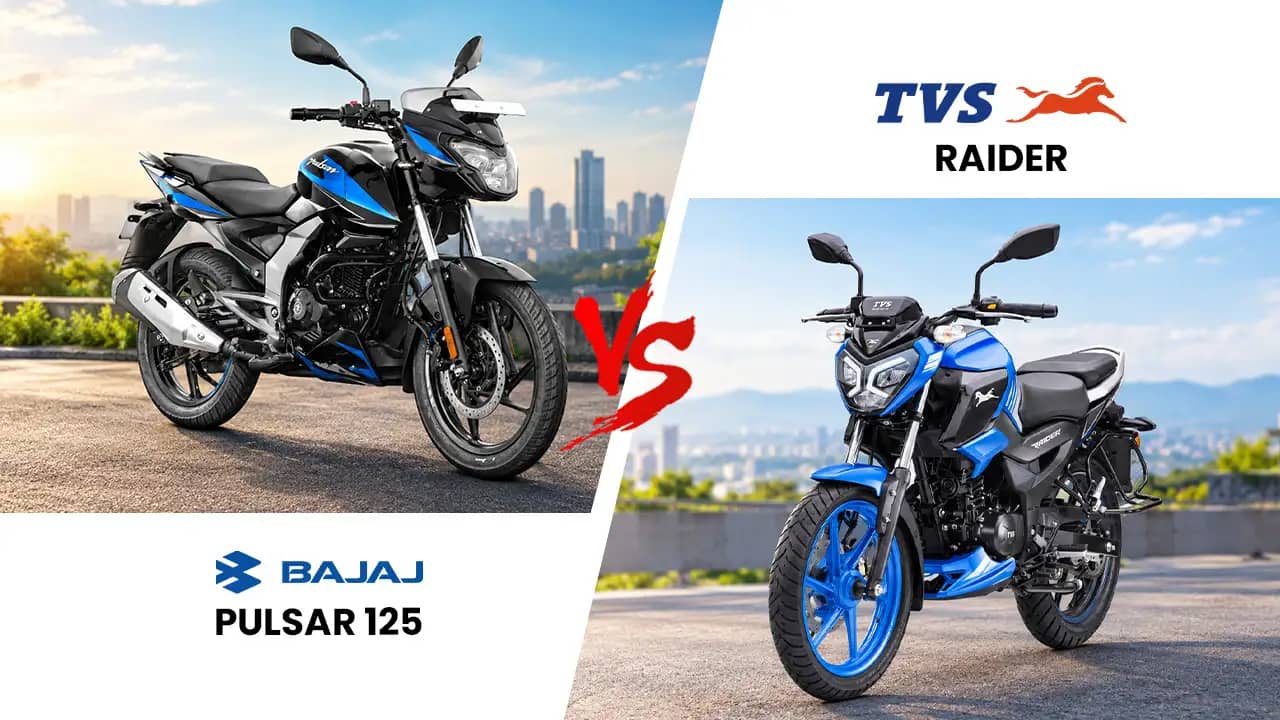
Two 125cc commuters, both close to ₹95,000 ex-showroom, are chasing the same Indian buyer. This Bajaj Pulsar 125 vs TVS Raider comparison covers current prices, estimated Delhi on-road cost, EMI, mileage and what each bike costs to fuel every month. It is written for first-time buyers and daily commuters choosing between Bajaj’s freshly updated Pulsar and TVS’s feature-heavy Raider.
The Bajaj Pulsar 125 vs TVS Raider contest now fits inside a ₹102 gap. Bajaj’s updated Pulsar 125 split-seat costs ₹94,518 ex-showroom. The Raider Split Seat asks ₹94,620 ex-showroom Delhi, after TVS raised prices by up to ₹2,600 on 1 October. Bajaj relaunched its 125 in late August with a new engine tune and a TFT screen. If you are an Indian rider with about ₹1.1 lakh to spend, sticker price no longer settles this. Running cost and equipment do.
Pulsar 125 vs Raider Price in India: What You Actually Pay
Start at the cheap end. The Raider Drum opens at ₹84,460, about ₹6,000 below the Pulsar 125 Neon at ₹90,494. Go the other way and the Raider TFT Dual Disc hits ₹1,03,170, nearly ₹9,000 above the costliest Pulsar. In the middle, the two are almost twins. Portals quote slightly different Pulsar figures, so treat these as launch-list prices and confirm at the showroom.
The on-road estimate assumes Delhi road tax at roughly 8% of ex-showroom plus ₹6,300-6,500 of insurance. Put ₹15,000 down on either bike and borrow the rest at 10% over 36 months, and the EMI lands near ₹3,020 for both. Finance cannot separate them. Fuel can.
Engine and Performance: Pulsar Has the Edge on Paper
The Pulsar’s 124.38cc engine now makes 11.93 bhp and 11.4 Nm, up from 11.63 bhp before the update. The Raider’s 124.8cc air-and-oil-cooled unit gives 11.2 bhp at 7,500 rpm and 11.2 Nm. Switch to Boost mode on the iGO trim and above, and torque rises to 11.75 Nm. Both use five-speed gearboxes, and TVS quotes a 99 km/h top speed for the Raider.
A 0.7 bhp gap sounds trivial, and at 125cc it mostly is. You will feel it on a flyover with a pillion, not at a traffic light. The more useful Pulsar addition is Crawl Tech, which lets the bike creep forward without throttle. In stop-go Indian traffic, that saves your wrist and your clutch hand.
Mileage and Monthly Fuel Cost
TVS claims an ARAI 56.7 kmpl for the Raider. The Pulsar 125 was rated up to 51.46 kmpl before the August update. I could not find a revised ARAI figure for the new tune, so treat roughly 51 kmpl as the likely number.
Real roads shave both. Expect about 52 kmpl from the Raider and 46 kmpl from the Pulsar in mixed city riding. Now run 1,200 km a month, around 40 km a day, with petrol at ₹103 a litre. The Raider drinks 23 litres and costs about ₹2,377. The Pulsar needs 26 litres and costs about ₹2,687. That is ₹310 a month, or ₹3,700 a year, handed to the petrol pump for the same ride.
Range is closer than you would think. The Pulsar’s 11.5-litre tank is good for roughly 530 km, and the Raider’s 10-litre tank for about 520 km.
Bajaj Pulsar 125 vs TVS Raider: Features and Ownership
Bajaj has packed the new Pulsar 125 with a 5-inch TFT, Google Maps navigation, full LED lighting, a USB Type-C port, multiple ride modes and a gas-charged rear monoshock. Clip-on handlebars give it a lower, sportier stance than the old model.
TVS counters with SmartXonnect Bluetooth, voice assist, call management and Boost mode from the iGO trim upwards. A TFT screen, though, comes only on the ₹1.03 lakh top variant.
Safety needs a closer look. The Raider’s single-channel ABS is limited to the SXC Dual Disc (₹1,00,330) and the TFT Dual Disc. The Pulsar is listed with a front disc and CBS, so ask the dealer exactly what braking hardware your variant carries.
Ownership tilts toward TVS. The Raider carries a 5-year or 60,000 km warranty. Its 780 mm seat and 180 mm ground clearance suit most Indian riders and potholed roads. Also look at the Hero Xtreme 125R and Honda CB125 Hornet, both direct rivals. Our earlier Xtreme 125R coverage is a useful third reference. If the Pulsar badge excites you but 125cc feels small, the Pulsar N160 is the obvious step up.
Which One Should You Buy?
In the Bajaj Pulsar 125 vs TVS Raider decision, the Raider wins for anyone who rides daily. Equal EMI, lower fuel bills and a longer warranty make it the cheaper bike to own, even though it loses on raw power. Choose the Pulsar if you want a stronger engine, a TFT screen and Crawl Tech at the same ₹94,500 mark, and your monthly riding is light enough that ₹310 does not matter.
If the budget is tight, the ₹84,460 Raider Drum is the cheapest way into either camp. You give up the connected features and ABS. If ABS matters, stretch to the SXC Dual Disc.
Whichever way you lean, the number that counts is the one in your city with your own down payment. Check the on-road price and EMI for the TVS Raider in your city on Drivio.
The Raider takes it for most daily riders. At 1,200 km a month it saves roughly ₹310 in petrol and comes with a five-year warranty. Pick the Pulsar if you want more power, a TFT screen and Crawl Tech for the same money. Anyone who cares about ABS should skip the cheaper Raider trims, because it arrives only on the top two.