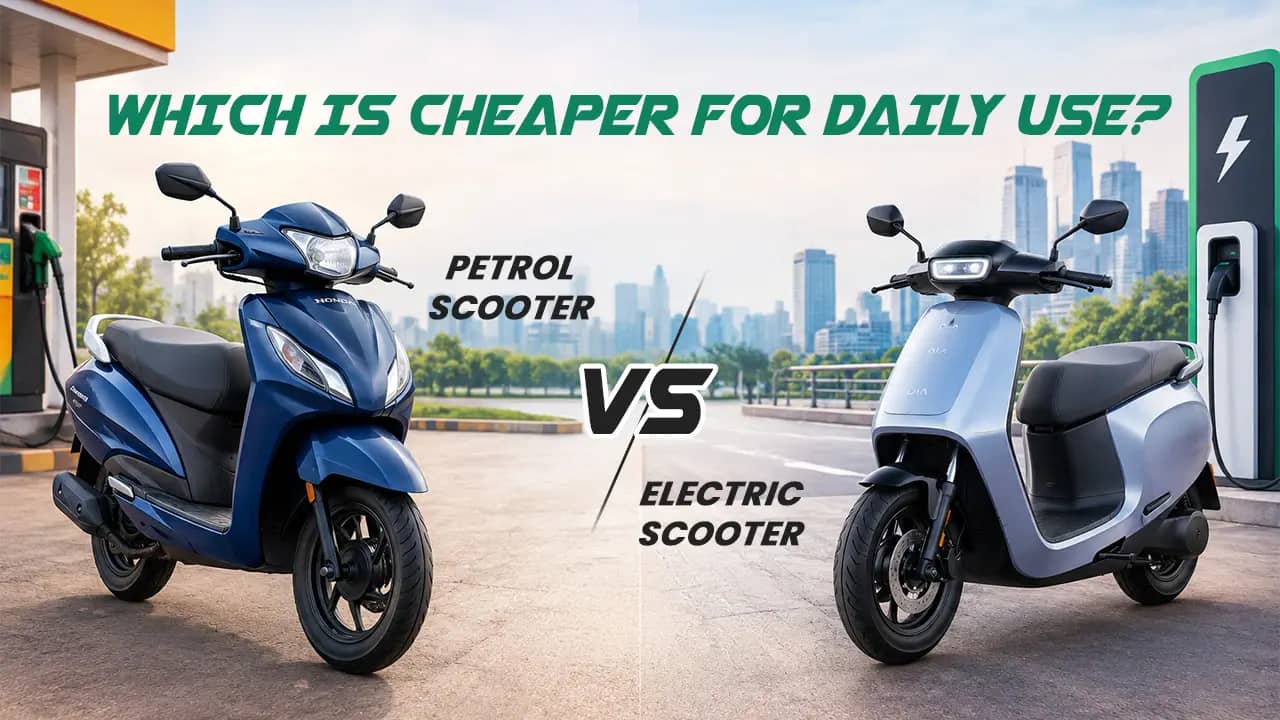
Overview
Choosing between a petrol scooter and an electric scooter is not only about the showroom price. The real difference appears after you add fuel or electricity, maintenance, insurance, repairs and resale value. This guide compares the major ownership costs so daily commuters can understand which scooter can deliver better value over several years.
For most buyers, a petrol scooter usually has the lower upfront purchase price, while an electric scooter can have the lower running and routine maintenance cost. The longer you keep and use the scooter, the more important the difference in energy cost becomes.
Upfront price: petrol has the early advantage
Petrol scooters are generally easier to position at lower entry prices because the technology is mature and the vehicle does not need a large traction battery. Electric scooters, by comparison, carry the cost of the battery pack, power electronics, motor and charging hardware.
However, comparing ex-showroom prices alone can create the wrong impression. On-road prices include items such as registration, insurance and other charges, and the final gap between two comparable scooters can be smaller than the headline ex-showroom difference.
For a buyer deciding only on day-one affordability, petrol can therefore look more attractive. But that is only the first line of the ownership-cost calculation.
Running cost: electricity can be dramatically cheaper
Running cost is one of the clearest reasons buyers consider electric scooters. A petrol scooter converts fuel into motion through an internal-combustion engine, while an electric scooter draws energy from the grid and uses an electric drivetrain.
An illustrative example makes the difference easier to understand. Suppose a petrol scooter costs about ₹2.09 per kilometre to run, while an electric scooter costs about ₹0.23 per kilometre based on a representative home-charging assumption. The exact numbers vary by fuel price, electricity tariff, efficiency, traffic and riding style, but the direction of the difference can be substantial.
At 33 km per day, the rider covers roughly 12,000 km a year. At ₹2.09 per km, annual petrol energy cost is about ₹25,000. At ₹0.23 per km, annual electricity cost is about ₹2,760. This is only an illustration, but it shows why high-mileage users can recover a higher purchase price faster.
Maintenance: why electric scooters can cost less routinely
Electric drivetrains have fewer moving parts than internal-combustion drivetrains. There is no engine oil, spark plug or conventional engine air-filter service, and many routine checks are simpler.
A typical electric scooter service schedule may focus on software updates, brakes, tyres, suspension, electrical systems and general inspections. A petrol scooter can require engine oil changes, air-filter servicing, spark-plug checks and additional engine-related maintenance.
A reasonable planning range for an electric scooter can be around ₹1,000–₹1,500 a year for routine maintenance, while a petrol scooter may average roughly ₹4,500–₹6,000 in a comparable illustrative scenario. Actual service bills vary significantly by model, usage, workshop and wear items.
Repairs: the equation changes for major components
Routine maintenance is not the same as major repair risk. Electric scooters have expensive components such as the battery pack, motor, controller and display. A failure outside warranty can therefore create a large one-time bill.
Battery replacement is the most important long-term question because the battery can represent a large share of an electric scooter’s original value. A motor or electronic component can also be costly compared with a normal service visit.
This is why warranty coverage matters when comparing electric scooters. Buyers should check battery warranty duration, mileage limits, state-of-health commitments and the coverage offered for major electrical components rather than looking only at the headline warranty period.
Battery life and charging matter more than fuel-stop convenience
Battery degradation is gradual rather than an all-or-nothing event. Usable capacity can decline over time depending on temperature, charging behaviour, battery chemistry, usage and system design. A strong battery-management system can help monitor temperature, charging and cell performance.
Charging convenience is equally important. Home charging can make an electric scooter simple for a daily commuter with predictable routes, while riders without a reliable charging point may value the faster refuelling experience of a petrol scooter.
The practical question is not only how far the scooter can travel on paper, but whether its usable range comfortably covers your daily route with a sensible charging routine.
Insurance: do not ignore the recurring cost
Insurance is another recurring ownership expense. Premiums vary by vehicle value, location, coverage, insurer, rider profile and policy type. An electric scooter with a higher insured value can have a different premium profile from a lower-priced petrol scooter.
When calculating long-term cost, use the actual annual premium for the specific scooter rather than assuming that one technology is always cheaper to insure.
Resale value: petrol currently has the safer assumption
Resale value can change the economics of the entire purchase. Petrol scooters generally have a more established used-vehicle market, so it can be easier to estimate their resale value after several years.
Electric scooters are a younger category. Their used-market value is influenced by battery health, remaining warranty, software and electronics, brand confidence, model age and the pace of new technology. A well-maintained electric scooter with strong battery health can still retain meaningful value, but resale assumptions should be conservative.
In a five-year planning scenario, one simple assumption might be around 50% retained value for a petrol scooter and around 30%–45% for an electric scooter. These are illustrative assumptions, not universal market rules.
Which scooter makes more sense for different riders?
A petrol scooter can make more sense when the buyer has a tight initial budget, rides relatively low annual kilometres, frequently travels long distances without planned stops, or does not have convenient charging access.
An electric scooter can make more sense for high-mileage urban commuting, predictable daily routes, home charging and buyers who care about lower routine running costs. The higher initial purchase price becomes easier to justify as annual kilometres increase.
The best decision is therefore usage-led: estimate your annual kilometres, electricity and fuel prices, routine service cost, insurance, expected holding period and likely resale value before choosing.
Conclusion
A petrol scooter can win on initial affordability, but an electric scooter can become cheaper to own as daily kilometres accumulate. The real comparison should include purchase price, energy cost, routine maintenance, insurance, major repairs and resale value. For low-mileage riders without easy charging, petrol may remain practical. For frequent urban commuters with reliable home charging, the lower running cost of an electric scooter can create a meaningful long-term financial advantage. This matters over the full ownership period for commuters.
Petrol scooters generally offer a lower upfront purchase price, while electric scooters can deliver significantly lower running and routine maintenance costs. For daily commuters covering higher distances, electricity savings can offset the initial price difference over time. However, buyers should also consider battery replacement costs, warranty coverage, insurance, charging convenience and resale value. Petrol scooters may suit budget-conscious buyers and riders without reliable charging access, while electric scooters are ideal for frequent urban commuting with home charging. Ultimately, the most economical choice depends on annual kilometres, ownership duration and total running costs.