Best Bike for Delivery Riders Doing 100+ km a Day: HF Deluxe vs CD 110 Dream vs Radeon
Overview
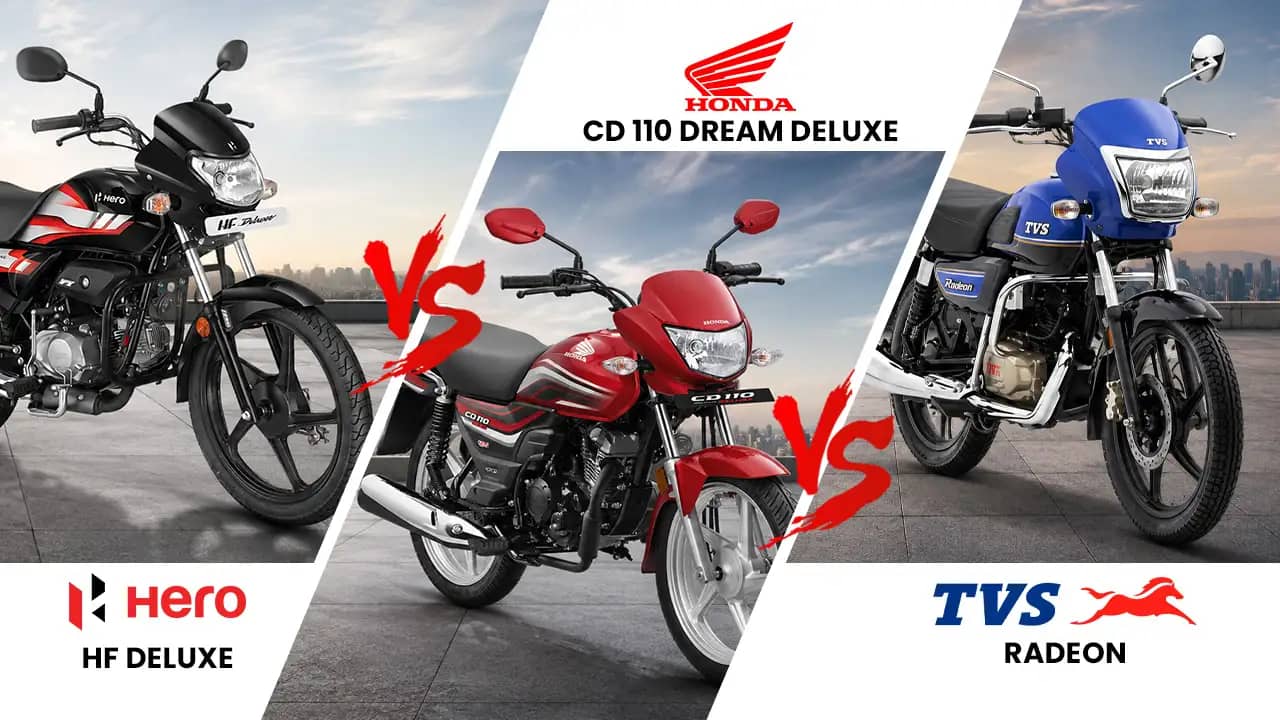
This comparison breaks down the best bike for delivery riders covering 100+ km daily in India, weighing the Hero HF Deluxe, Honda CD 110 Dream Deluxe and TVS Radeon on real-world mileage, not just ARAI claims. It covers ex-showroom and on-road pricing in Delhi, EMI at 20% down over 60 months, and actual monthly fuel cost at ₹103/litre for a 3,000 km delivery month. The piece also looks at service costs at the 10,000 km mark and network reach across metro and smaller-town dealerships, ending with a clear verdict on which bike minimizes combined running cost for gig-economy riders.
The best bike for delivery riders covering 100 km or more a day in India right now comes down to three 110cc commuters: the Hero HF Deluxe (starting ₹59,477 ex-showroom), the Honda CD 110 Dream Deluxe (₹73,400) and the TVS Radeon (₹58,450). All three sell in volumes that dwarf premium motorcycles precisely because gig-economy riders for Zomato, Swiggy, Rapido and courier fleets need a machine that survives 3,000 km a month without eating into what's left after fuel and EMI. That distinction — running cost per kilometre rather than horsepower — is what actually separates these three, not spec-sheet bragging rights.
Best Bike for Delivery Riders: How the Numbers Stack Up
None of these bikes will win a drag race against each other; they're within half a bhp of one another and every review site will tell you that. What they won't tell you upfront is how differently they behave once you're doing eight to ten hours of stop-start riding daily, fully loaded with a delivery box on the back. Here's where they land on paper.
The Radeon's torque peaks earliest, at 4,500 rpm, which matters more than the number suggests — it means less gear-hunting in Delhi or Bengaluru traffic where a delivery rider might shift four times in one signal cycle. The CD 110 Dream has the highest headline output of the three thanks to Honda's eSP tuning, but that also comes at the highest price point here.
Real-World Mileage for a 100 km-a-Day Rider
ARAI figures are lab numbers on a dyno with no rider weight bias, no delivery box drag, and no traffic. Real-world reports from owners tell a different story. HF Deluxe owners running full days typically report 60-63 kmpl rather than the claimed 65. The CD 110 Dream, heavier at 112 kg and tuned for punchier low-end response, tends to settle around 56-58 kmpl once you factor in constant acceleration from a stop. The Radeon holds up best under load — its ARAI-claimed 73.69 kmpl drops to somewhere between 63 and 68 kmpl in daily delivery use, according to owner-reported data on BikeWale, but that's still comfortably ahead of the other two. For someone clocking 3,000 km a month, that gap isn't trivia — it's real money, which is the next thing to work out.
Fuel Cost on a 3,000 km Delivery Month
At Delhi petrol prices of roughly ₹103 a litre, running the HF Deluxe at a conservative real-world 62 kmpl costs about ₹4,984 a month in fuel for 3,000 km. The CD 110 Dream, at a real-world 58 kmpl, works out to roughly ₹5,328 a month. The Radeon, at 65 kmpl under load, comes in cheapest at around ₹4,754 a month. Stack that up over a year and the Radeon saves a rider close to ₹6,900 against the CD 110 Dream, and around ₹2,760 against the HF Deluxe — money that stays in the rider's pocket rather than going to the pump.
EMI and On-Road Cost Compared
Financing changes the calculation too. On a standard 20% down payment, 60-month tenure at 11% interest, the on-road prices above translate to an EMI of roughly ₹1,428 a month for the HF Deluxe self-start alloy variant, ₹1,491 a month for the CD 110 Dream Deluxe, and just ₹1,191 a month for the TVS Radeon. Add EMI and fuel together and the Radeon costs a delivery rider around ₹5,945 a month, against ₹6,412 for the HF Deluxe and ₹6,819 for the CD 110 Dream. That's a gap wide enough to matter on a gig-economy income where every rupee of daily earnings is tracked.
Service Cost and Reliability Over 10,000 km
All three brands run dense authorized service networks, which matters as much as the bike itself for someone who can't afford three days off the road waiting for a spare part. Typical service costs for entry commuters like these run around ₹800-1,200 per visit at the 10,000 km mark, covering an oil change, chain adjustment and consumables — Hero and Honda tend to sit at the lower end of that range because parts for their bestsellers are cheap and everywhere, while Radeon owners occasionally report slightly higher part costs outside metro cities simply because TVS's rural network is thinner than Hero's. If you're riding in a smaller town rather than Delhi or Mumbai, that's worth checking before you commit.
The Verdict for Delivery Riders
For a rider clocking 100+ km daily, the TVS Radeon is the sharpest financial choice of the three — the lowest ex-showroom price, the lowest on-road cost, the best real-world mileage, and the lowest combined EMI-plus-fuel outgo every single month. The Hero HF Deluxe remains the safer bet if service-network density in a smaller town outweighs the fuel savings, since Hero's after-sales reach is still unmatched in India. The Honda CD 110 Dream makes sense only if you value Honda's eSP refinement and slightly stronger low-end pull over outright running cost, which most delivery riders can't afford to prioritize. If you're also weighing the Hero Splendor Plus or Honda Shine 100 in this segment, both trade a bit of that fuel efficiency for a stronger resale value. Check the on-road price and EMI for the TVS Radeon, Hero HF Deluxe or Honda CD 110 Dream Deluxe in your city on Drivio.
Among the three, the TVS Radeon comes out cheapest to own and run for delivery riders, combining the lowest on-road price (₹68,449 in Delhi), the best real-world mileage (63-68 kmpl under load) and the lowest EMI-plus-fuel outgo at roughly ₹5,945 a month. The Hero HF Deluxe suits riders prioritizing service-network density in smaller towns, while the Honda CD 110 Dream Deluxe appeals mainly for its stronger low-end torque and Honda refinement, at a higher monthly cost than either rival.