TVS Ntorq 150 Launched in Nepal at NPR 3.69 Lakh: What Indian Buyers Should Know
Overview
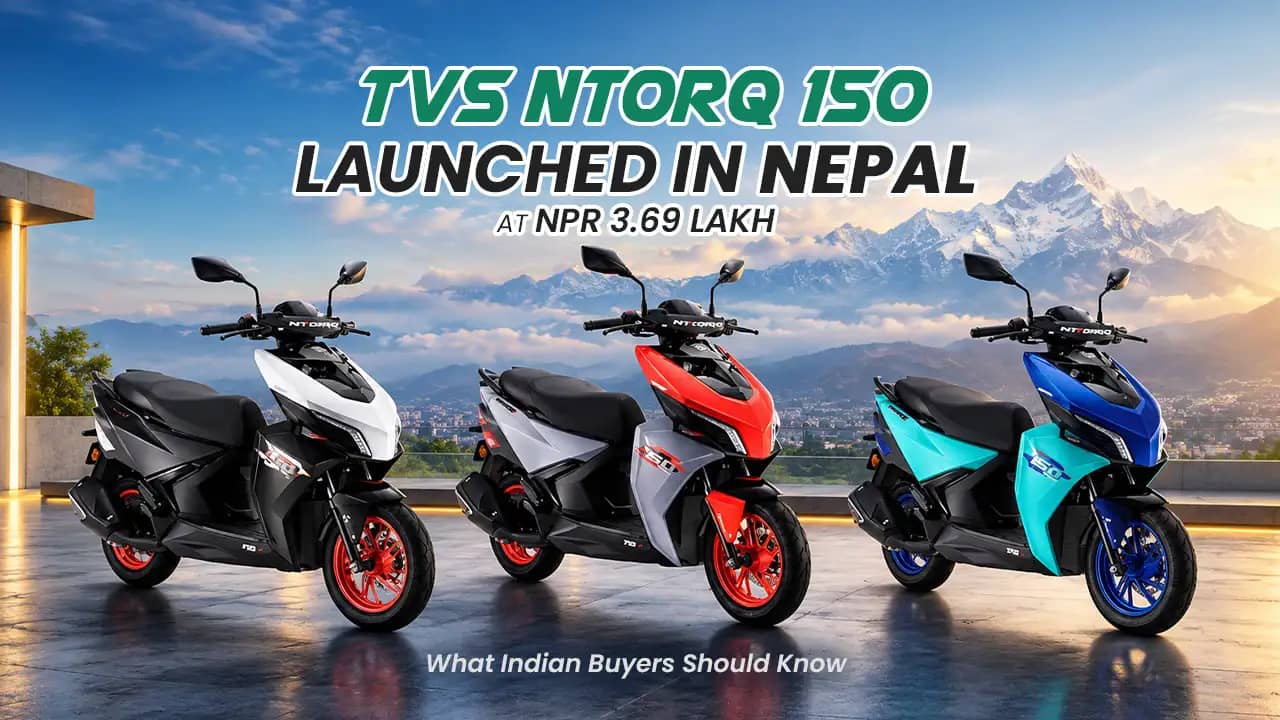
TVS Motor has launched the Ntorq 150 in Nepal at an introductory NPR 3,69,900, roughly ₹2.31 lakh, making Nepal the first overseas market for the 150cc hyper sport scooter. Sales run through Jagdamba Motors in Stealth Silver, Racing Red and Turbo Blue. The scooter uses a 149.7cc O3CTech engine making 13.2 PS and 14.2 Nm, with ABS, traction control and over 50 connected features. In India, the same scooter starts at ₹1.12 lakh ex-showroom, so Nepali buyers pay nearly double for identical hardware.
The TVS Ntorq 150 launched in Nepal on 26 September at an introductory NPR 3,69,900, which is roughly ₹2.31 lakh at the fixed 1.6 exchange rate. In India, the same scooter starts at ₹1.12 lakh ex-showroom. Nepal is the first overseas market to get TVS's 150cc hyper sport scooter, and the gap between the two price tags shows Indian buyers how good their deal is.
Why the TVS Ntorq 150 launched in Nepal costs nearly double
The launch took place in Naxal, Kathmandu. Jagdamba Motors, TVS's sole distributor in Nepal, is handling sales. Three colours are on offer: Stealth Silver, Racing Red and Turbo Blue. Indian buyers get a fourth, Nitro Green. A few reports print the Nepal price with a ₹ sign, but it is Nepali rupees.
The Ntorq 125 range in Nepal used to top out at NPR 3,34,900 for the XP variant, so the 150 lifts the nameplate's ceiling by about NPR 35,000. Nepal's import duties on vehicles account for most of the rest. After conversion, the Nepal price is 2.06 times India's Standard ex-showroom figure, a difference of about ₹1.19 lakh. The 149.7cc engine, the ABS and the traction control are the same. Only the tax bill changes.
Ntorq 150 price in India: ex-showroom and Delhi on-road
The Standard variant costs ₹1,12,300 ex-showroom and the TFT ₹1,21,300. Add RTO charges and insurance, and a Delhi buyer typically pays about ₹1,27,968 on-road for the Standard (₹8,984 RTO, ₹6,684 insurance) and ₹1,37,859 for the TFT. Dealer add-ons and Mumbai's higher road tax will shift these numbers, so treat them as a reference and not a quote.
What the EMI actually looks like
Most price listings stop at the on-road figure. Put 20% down on the Standard's Delhi on-road price, about ₹25,594, and you borrow ₹1,02,374. Over 60 months at 11%, the EMI comes to roughly ₹2,226 a month, with about ₹31,000 paid as interest over the loan. The TFT pushes the EMI to about ₹2,398. That is the real monthly cost of choosing the TFT's colour display, and it is small.
What the Nepal-spec scooter gets: engine, power and tech
The scooter runs a 149.7cc, air-cooled, single-cylinder O3CTech engine with a CVT. It makes 13.2 PS at 7,000 rpm and 14.2 Nm at 5,500 rpm. TVS claims 0-60 km/h in 6.3 seconds and a top speed of 104 km/h, and calls it the quickest scooter in its class. Those are launch claims, not road-test numbers. Expect brisk gaps-in-traffic pickup, not a superbike shove.
The Nepal-spec scooter has ABS and traction control. More than 50 connected features include turn-by-turn navigation and switchable ride modes. In India, the TFT variant adds the colour display that carries most of that tech. Everyday practicality is less glamorous but matters more. You get 22 litres of underseat storage, a front glove box, a 5.8-litre tank and 12-inch wheels.
Ntorq 150 mileage and what it costs to run each month
ARAI claims 40 kmpl. Owners on listing sites report closer to 30-35 kmpl in city riding, which is the figure worth budgeting with. At ₹103 a litre and 1,000 km a month, 35 kmpl means about ₹2,943 in petrol. At the full 40 kmpl it drops to ₹2,575. The 5.8-litre tank gives a real-world range of around 200 km before you hunt for a pump.
Add the ₹2,226 EMI and the monthly outgo lands near ₹5,170 before servicing. The 10,000 km service is likely to cost ₹1,200 to ₹1,800, going by what Ntorq 125 owners report. Treat that as an estimate until TVS publishes a 150 schedule.
Ntorq 150 vs Aerox 155 and the rest of the class
In India, the closest rivals are the Yamaha Aerox 155, Hero Xoom 160 and Aprilia SR 175. The Aerox makes roughly 15 PS, so the TVS gives up some outright power. It answers with a longer feature sheet and a lower price. Honda's ADV 160 starts at ₹1.70 lakh, which is ₹57,700 more than the base Ntorq, so it is a different budget conversation altogether.
In Nepal, the fight is with Honda, Yamaha, Suzuki and Aprilia scooters. At NPR 3.69 lakh, buyers can also start looking at entry-level motorcycles. That is a harder sell than in India. If ₹2,900 a month in petrol bothers you, Drivio has covered the electric route with the TVS iQube and Ather 450X.
Buy or wait: the verdict
The TVS Ntorq 150 launched in Nepal, but nothing changes for Indian buyers except bragging rights. You cannot import one, and you would not want to at twice the price. In India, buy the Standard at about ₹1.28 lakh on-road if you want a quick, sharp-looking 150cc scooter and can live with 30-35 kmpl. Pay ₹9,000 more for the TFT only if you use phone navigation daily. Skip both and test the Aerox 155 if outright power matters more than features. Check the on-road price and EMI for the TVS Ntorq 150 in your city on Drivio.
For Indian buyers, the Nepal launch changes nothing on the price sheet. The Ntorq 150 costs ₹1,27,968 on-road in Delhi for the Standard variant, and the EMI works out to about ₹2,226 a month on 20% down over 60 months at 11%. Real-world mileage of 30-35 kmpl means roughly ₹2,943 in monthly petrol at ₹103 a litre. Buy the Standard for the best value, pick the TFT only for daily navigation, and test the Yamaha Aerox 155 if you want more power.