2026 Bajaj Pulsar RS200 Launched at ₹1.98 Lakh: TFT, USD Forks and Traction Control
Overview
Bajaj has updated its fully faired 200cc sportbike for India, and the 2026 Bajaj Pulsar RS200 now costs ₹1,98,441 ex-showroom Delhi. This piece covers what the extra money buys: a TFT console, five ride modes, traction control, USD forks and a radial rear tyre. It also tests the price against the Hero Karizma XMR and works out EMI and monthly fuel cost for anyone considering a sportbike under ₹2.5 lakh.
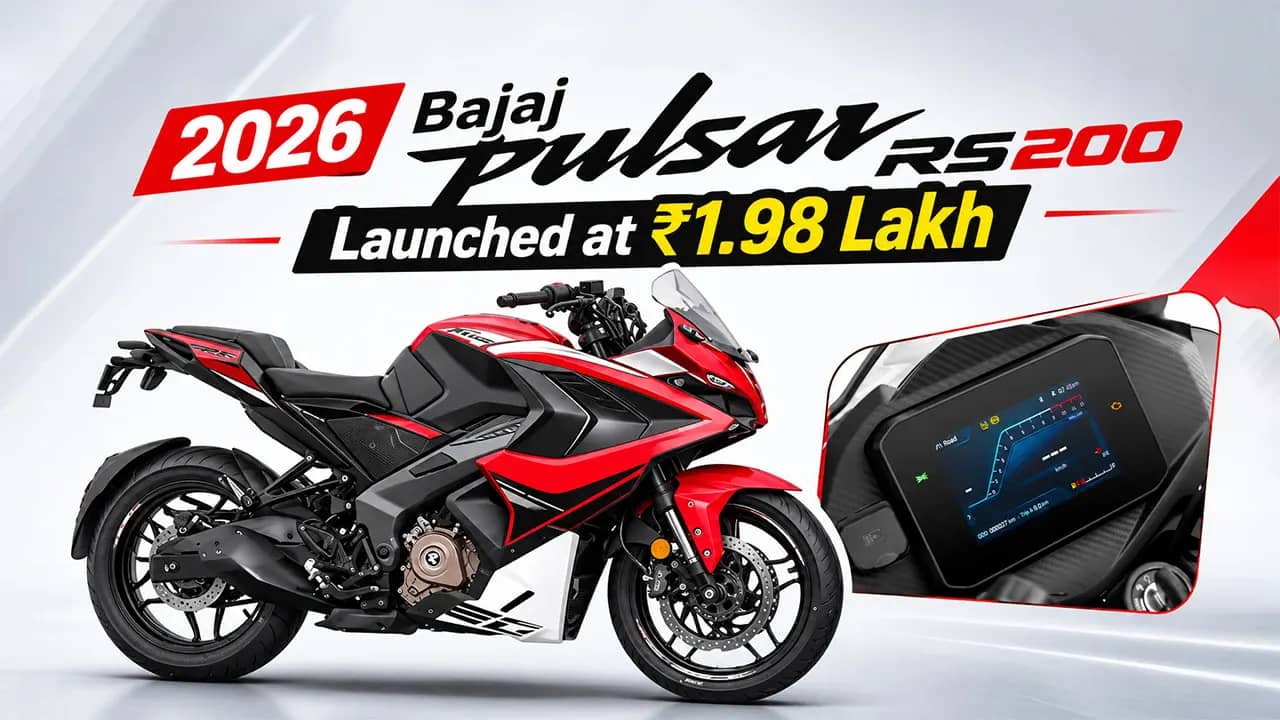
The 2026 Bajaj Pulsar RS200 is now on sale in India at ₹1,98,441 ex-showroom Delhi, about ₹27,000 more than the outgoing model’s ₹1.71 lakh tag. Bajaj’s fully faired Pulsar had been running on a decade-old electronics package, and this update fixes that in one go: a 5-inch TFT display, five ride modes, traction control and USD forks, plus a small power bump. If a 200cc sportbike is on your shortlist this month, both the price gap and the kit list matter.
What the 2026 Bajaj Pulsar RS200 Gets for the Extra ₹27,000
Start in the cockpit. The 5-inch colour TFT replaces the earlier colour LCD and mirrors Google Maps from your phone, which counts for plenty on a Delhi-NCR commute where one missed flyover turn means a long detour. Adjustable hand levers, a USB Type-C port, a hazard switch and a Panic Brake Alert complete the controls.
The bigger change is invisible. An electronic throttle body now sits on the engine, and it is what makes the five modes possible: Sport, Road, Rain, Off-Road and Tour. Traction control rides along, trimming power when the rear wheel starts to slip. On Indian roads, where monsoon slush or wind-blown sand can appear mid-corner, that matters more than another bhp.
Engine, tyre and suspension
The 199.5cc liquid-cooled single makes 25.1 bhp (25.5 PS) and 18.7 Nm. Power is up one bhp from the old 24.1 bhp, and torque stays put. You will not feel one bhp. You will notice how the throttle responds through the electronic throttle body, and there is a new Sports Shifter whose workings Bajaj hasn’t explained yet. Treat it as unconfirmed until a proper road test lands.
The hardware changes are easier to judge. Conventional forks give way to 37mm USD units up front, and the rear now carries a 140/70-R17 radial. Wheel size is unchanged, but a radial should hold a steadier contact patch when the bike is leaned over on wet tarmac. Styling is otherwise untouched, and colours run to Brooklyn Black, Pearl Metallic White, Caribbean Blue and Racing Red.
RS200 Price in India: On-Road Cost, EMI and Monthly Running Cost
The RS200 price in India now reads ₹1,98,441 ex-showroom Delhi. Bajaj launched the previous update in January 2025 at ₹1.84 lakh, so the jump is roughly ₹14,000 on that and ₹27,000 on the ₹1.71 lakh the outgoing bike was listed at. Add RTO, insurance and handling charges and the RS200 on-road price should land near ₹2.33 lakh in Delhi and ₹2.40 lakh in Mumbai. Those are estimates built from the on-road-to-ex-showroom ratios on comparable bikes today, not dealer quotes, so wait for a showroom sheet before you plan around them.
Financing is where the number gets personal. Put down 20 per cent, which is ₹39,688, and borrow ₹1.59 lakh over 60 months at 11 per cent: the RS200 EMI works out to about ₹3,450 a month, with roughly ₹48,000 paid as interest across five years. That is on the ex-showroom price. Finance the estimated on-road amount instead, with the same 20 per cent down, and the instalment climbs to about ₹4,050.
Fuel comes next. The outgoing bike carried an ARAI figure of 35 kmpl, and Autocar India’s listing puts real-world mileage at 32 to 36 kmpl. Bajaj hasn’t published a number for the updated bike, so that is the working range for RS200 mileage. At ₹103 a litre, a rider covering 1,000 km a month spends ₹2,940 to ₹3,220 on petrol, roughly ₹3 a kilometre. EMI plus petrol lands near ₹6,550 a month before insurance renewals and tyres.
Service cost is the one figure that has to stay an estimate: a routine service at 10,000 km should run ₹1,500 to ₹2,000, though Bajaj hasn’t published a rate. What is certain is the reach. Bajaj’s service network runs deep into small-town India, and that shapes ownership cost more than any spec line.
RS200 vs Karizma XMR: Where the Extra Money Goes
Both bikes make 25.5 PS. The Hero has the torque advantage, 20.4 Nm against 18.7 Nm, and costs ₹11,000 to ₹18,000 less depending on variant and city. That works out to about ₹7,300 per PS for the Karizma XMR against ₹7,780 for the RS200.
What Bajaj sells for the premium is electronics. The Karizma XMR, in its current form, has no ride modes or traction control. The Yamaha R15 V4 plays a different game: a 155cc engine making about 18 PS, seven short of the RS200, but with a reputation for sharper handling and traction control of its own. If agility matters more than straight-line pull, it deserves a test ride too.
Buy Now or Wait for the Road Test?
The hardware list is real and the pricing is defensible. Two things are still missing: an updated mileage figure and any detail on how the Sports Shifter works. A first-ride review should answer both.
Riders who spend weekdays in stop-and-go traffic and weekends on highways get the most from the 2026 Bajaj Pulsar RS200. Tour and Rain modes, traction control and navigation on the dash all earn their keep there. Anyone who simply wants a faired 200cc with a respectable power figure can save ₹11,000 or more with the Karizma XMR. Drivio’s report on the Pulsar 180 being discontinued is useful context for where the RS200 now sits in Bajaj’s range, and our list of the best bikes under ₹3 lakh for riders upgrading from a commuter covers the next rung if your budget stretches.
The updated RS200 is the one to pick if traction control, ride modes and a proper TFT matter to you in a faired bike around ₹2.3 lakh on-road. Riders who put mileage first should test the Karizma XMR before booking. Budget roughly ₹3,450 a month for the loan and about ₹3,100 for petrol, and the RS200 becomes a ₹6,500-a-month proposition.