Benda Rock 707 Air Suspension Explained: Why This V-Twin Cruiser Sinks 30mm at Every Stop
Overview
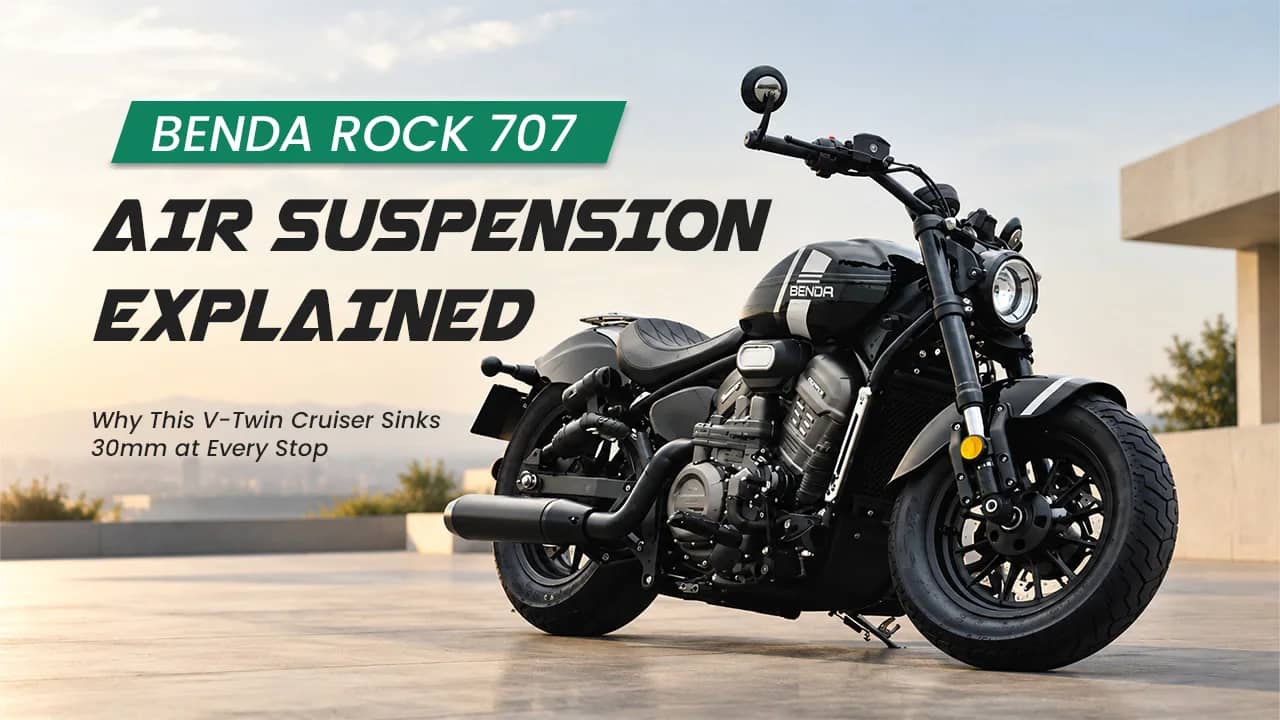
The Benda Rock 707 is a 692cc V-twin cruiser that comes with electronically controlled rear air suspension and an electronic clutch. Its dual-chamber air units drop the bike by 30mm at every stop, taking seat height from 720mm to 690mm, and level the rear for rider and pillion weight. Benda has priced it at €9,999 in Germany, with no confirmed India launch yet. If it arrives, we expect around ₹9.5 lakh ex-showroom, placing it above the Kawasaki Vulcan S at ₹8.13 lakh.
The Benda Rock 707 air suspension drops the rear of this 692cc V-twin cruiser by 30mm every time you come to a stop, and that one trick has put a Chinese cruiser on Indian riders' radar. Benda has priced the bike at €9,999 in Germany, with European dealers getting stock from mid-September. India has no confirmed launch. If it does arrive, expect an ex-showroom price near ₹9.5 lakh. That is our estimate, not a Benda figure, and it would sit just above the ₹8.13 lakh Kawasaki Vulcan S.
Why does the Benda Rock 707 have air suspension?
Because cruisers are heavy and low, and this one is both. Kerb weight is 235kg, and the seat moves between 690mm and 720mm depending on whether the bike is rolling. Benda quotes a nominal 705mm. Parked at a red light, the Rock 707 sits 15mm lower than the fixed 705mm seat on the Vulcan S. That matters where Indian riders actually stop: a cambered road at a signal, a toll queue, a petrol pump forecourt that slopes toward the drain. A shorter rider holding up 235kg on tiptoe at a jammed junction at 6pm will feel those 30mm.
Load is the second reason. A cruiser in India rarely carries only its rider. Add a pillion and a saddlebag, and a conventional preload-adjustable shock squats, which most owners never readjust. Benda's system reads the weight and levels the rear on its own.
How the Benda Rock 707 air suspension actually works
Two dual-chamber, electronically controlled air units replace the usual pair of steel-spring shocks at the rear. They respond to rider and pillion weight and to road conditions, so both height and firmness change without you touching anything. The drop-and-rise is automatic, and press photos show a button on the left switchgear for the lowering function. Only the rear is air-sprung. Up front sits a non-adjustable upside-down fork, with a 320mm disc and a four-piston radial caliper.
The idea isn't new. Harley-Davidson's Adaptive Ride Height, first seen on the Pan America 1250 Special, lowers the bike at a stop using electronic spring preload instead of air. Benda has been building toward its own version for a while. The LFC 700 Pro already runs a single dual-chamber monoshock with a 650-720mm range and speed-sensitive damping, and the Rock 707 is a simpler twin-shock take on the same thinking.
Then there is the clutch. Benda's BEC MK-III electronic clutch lets you pull away, shift and stop without touching the lever, much like Honda's E-Clutch, and the manual lever stays for anyone who wants it. Put the two systems together and the plan is obvious: make a 235kg cruiser painless in traffic.
Benda Rock 707 vs Kawasaki Vulcan S and Super Meteor 650
On paper the Benda wins the spec sheet by a distance. It makes 12 PS and 7 Nm more, and it adds cruise control, traction control, a 3.6-inch TFT and the electronic clutch. The Vulcan S makes do with an analogue tachometer and a small LCD. What the Kawasaki has is a dealer network Indian owners already know, and a price roughly ₹1.4 lakh lower by our estimate.
The Royal Enfield Super Meteor 650, from ₹3.99 lakh, belongs in the conversation too, mainly as a reminder of how much cheaper the sensible option is. It costs less than half of what the Rock 707 is likely to. Nobody buys a Super Meteor for its electronics, though.
Benda Rock 707 price in India, EMI and monthly running cost
At our expected ₹9.5 lakh ex-showroom, the on-road price in Delhi should land around ₹10.7 lakh once road tax, insurance and registration are added. Mumbai will run higher. On the standard 20% down, 60 months, 11% interest structure, that means ₹1.9 lakh upfront and an EMI of about ₹16,500. The Vulcan S on the same terms works out to roughly ₹14,100, so you pay about ₹2,400 a month for the Benda's extra tech.
Fuel is the smaller number. We expect around 20 kmpl in mixed riding from a 235kg twin of this size. At 1,000 km a month, that is 50 litres, or ₹5,150 at ₹103 a litre. Add the EMI and the monthly outgo sits near ₹21,650 before insurance and servicing. The belt drive means no chain cleaning or tensioning, but Benda hasn't published service intervals or belt life, so a 10,000 km service bill is anything but a known number.
Should Indian riders trust an air spring?
This is the real question, and the spec sheet doesn't answer it. Air suspension adds parts that a steel spring never needed: air chambers, a pump, pressure and ride-height sensors, a control unit. The Benda Rock 707 air suspension has barely been on sale anywhere, so nobody has data on how those seals and that pump age in 45-degree summers, monsoon flooding and years of pothole hits. Benda sits under the Qianjiang Group alongside Benelli and Keeway, both sold in India, which hints at a route to market. A hint is not a commitment, and no India launch plan exists.
Ground clearance is the other blank. The Vulcan S makes do with 130mm and scrapes on bigger speed breakers. The Rock 707 rises by 30mm once you are moving, which could help, but Benda hasn't published a clearance figure, so treat that as a question rather than a benefit.
Verdict: wait, then decide on service, not spec
If you're a shorter rider, or you carry a pillion often, the Rock 707 makes a stronger case than the Vulcan S. The height drop and the self-levelling rear solve problems the Kawasaki only tolerates. Everyone else should hold off. Until Benda confirms local assembly, a service network and a price under ₹10 lakh, the Vulcan S is the safer buy, and the Super Meteor 650 is the smarter one. The Benda Rock 707 air suspension is a clever answer to a real problem, but cleverness needs a workshop within reach to be worth owning. When Benda names an Indian price, check the on-road price and EMI for the Benda Rock 707 in your city on Drivio.
The Rock 707 gets air suspension to make a heavy 235kg cruiser easier in traffic and to keep the rear level with a pillion or luggage. It makes 73 PS and 68 Nm, and adds cruise control, traction control and a TFT display. Against the Vulcan S it offers more power and tech, but at roughly ₹2,400 extra per month in EMI on our estimate. The concern is long-term reliability and service support in India. Verdict: wait for Benda's India plans before deciding.