Ather Konarc Launched at ₹99,999: Can It Be the Best Electric Replacement for Your Petrol Bike?
Overview
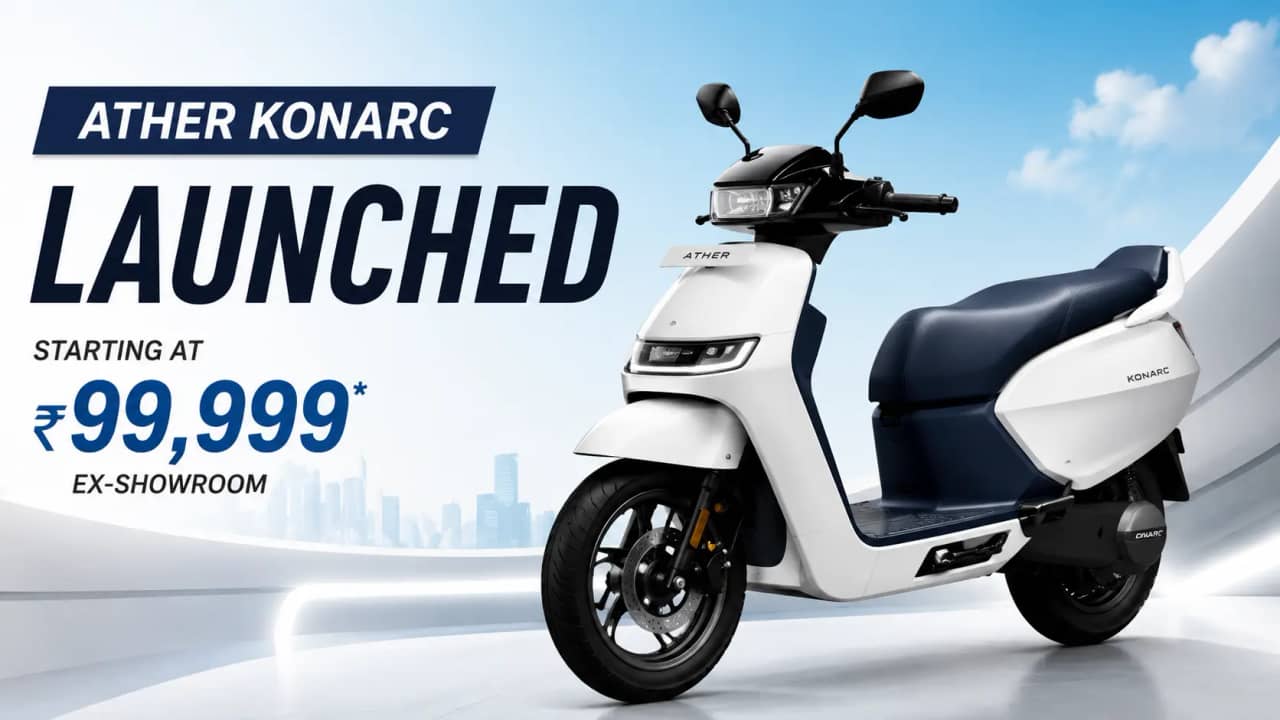
Ather has launched the Konarc, its first electric scooter based on the new EL platform, at a starting price of ₹99,999 ex-showroom. Designed as a practical alternative to the performance-focused 450 range, the Konarc prioritises everyday usability, easier charging and simpler servicing. The S line is offered with 100km, 125km and 161km IDC range options, while the 200km S and Z variants are planned for later.
Ather Energy has launched the Konarc in India at a starting price of ₹99,999 (ex-showroom), introducing a new electric scooter platform aimed at everyday commuters and family users rather than performance-focused riders. The Konarc is the first production model based on Ather's new EL platform, which has been developed around simpler hardware, easier charging, quicker servicing and more practical everyday usability.
The Konarc is available in the S and Z lines, with multiple battery and range configurations. The Konarc S currently gets 100km, 125km and 161km IDC range versions priced at ₹99,999, ₹1,21,999 and ₹1,44,999 respectively. The 200km S and both Z variants are yet to receive prices. Ather's official specifications list the 100km, 125km and 161km versions with 2.1kWh, 2.7kWh and 3.5kWh batteries, while top speed remains 70km/h.
The first deliveries of the 125km and 161km versions are expected from September 2026, followed by the 100km version in Q1 2027. The 200km S is planned for Q3 2027, while the Z variants are scheduled for Q2 2027.
What is the Ather Konarc?
The Konarc represents a significant change in Ather's product strategy.
The company's 450 series is built around performance, while the Rizta focuses on family comfort and practicality. The Konarc goes one step further towards mainstream commuting by putting cost, simplicity and everyday usability at the centre of the product.
Ather says the EL platform was developed using 26 lakh kilometres of field data. The company has also worked to reduce component complexity, claiming that assembly can be around 15% faster and periodic servicing can be up to twice as quick.
That makes the Konarc less about being the fastest electric scooter and more about answering a much bigger question:
Can an EV simply replace the petrol two-wheeler that millions of Indians already use every day?
For many buyers, that may be exactly where the Konarc makes the most sense.
Ather Konarc: Key Specifications
| Specification | Ather Konarc S 100 | Konarc S 125 | Konarc S 161 |
|---|---|---|---|
| IDC Range | 100 km | 125 km | 161 km |
| TrueRange | 80 km | 100 km | 130 km |
| Battery | 2.1 kWh | 2.7 kWh | 3.5 kWh |
| Top Speed | 70 km/h | 70 km/h | 70 km/h |
| Peak Power | 4 kW | 4.7 kW | 4.7 kW |
| Peak Torque | 16 Nm | 16 Nm | 16 Nm |
| Front Wheel | 14-inch | 14-inch | 14-inch |
| Suspension Travel | 100 mm front | 100 mm front | 100 mm front |
| Charging | 450W onboard | 450W onboard | 450W onboard |
| Ex-showroom Price | ₹99,999 | ₹1,21,999 | ₹1,44,999 |
Ather's official specifications show a 70km/h top speed across the current S variants, with the larger battery versions offering progressively greater certified and claimed TrueRange.
The Konarc also gets a 1,352mm wheelbase and a larger 14-inch front wheel. That combination should make it feel more stable than a small, lightweight commuter scooter, particularly on broken city roads.
The longer-travel front suspension and larger wheel are particularly important for Indian road conditions, where potholes, speed breakers and uneven surfaces are part of everyday riding.
Why the Konarc Is Different From the Ather 450
The biggest mistake would be to look at the Konarc as a cheaper 450.
It isn't.
The two scooters are designed for very different customers.
The latest Ather 450S offers a 90km/h top speed and 122km/161km IDC range, while the 450X also reaches 90km/h with 126km/161km range. The 450 models are clearly positioned as performance-oriented electric scooters.
The Konarc, by comparison, tops out at 70km/h.
That sounds like a disadvantage on paper, but for a typical city commuter it may not be one.
A rider using a scooter for:
office commuting
market visits
college travel
school runs
family use
short inter-city trips
does not necessarily need a 90-100km/h electric scooter.
The Konarc instead offers a more relaxed riding character, a large front wheel, long-travel suspension and features designed around convenience.
Konarc vs Ather 450
| Factor | Ather Konarc | Ather 450 |
|---|---|---|
| Primary purpose | Everyday commuting | Performance + commuting |
| Top speed | 70 km/h | Up to 100 km/h |
| Character | Comfortable and practical | Fast and sporty |
| Platform | New EL platform | 450 platform |
| Front wheel | 14-inch | 12-inch |
| Best for | Families and commuters | Enthusiastic riders |
| Focus | Practicality + cost | Performance + technology |
The Ather 450 remains the better choice for someone who enjoys acceleration and wants stronger highway capability. The Konarc makes more sense for the buyer who simply wants a dependable daily-use EV.
Konarc vs Ather Rizta: Which Ather Is Better for Families?
This is probably the most important comparison inside Ather's own portfolio.
The Rizta was designed specifically as Ather's family scooter. It has a 56-litre overall storage solution including 34 litres of under-seat storage and an optional 22-litre front storage accessory. It also offers a large seat, 80km/h top speed and up to 161km IDC range.
The Konarc, however, takes a somewhat different approach.
It uses a 14-inch front wheel, 100mm front suspension travel and a 1,352mm wheelbase, and Ather has added a padded pillion grab handle and adjustable backrest.
That suggests the Konarc is being designed around stability and regular two-person usage rather than simply maximizing storage.
Konarc vs Rizta
| Feature | Ather Konarc | Ather Rizta |
|---|---|---|
| Focus | Everyday commuter | Family scooter |
| Top speed | 70 km/h | 80 km/h |
| IDC Range | 100-161 km currently | 123-161 km |
| Front wheel | 14-inch | 12-inch |
| Storage | Yet to be positioned as its main strength | 34L boot + optional frunk |
| Pillion comfort | Adjustable backrest | Large family-oriented seat |
| Starting price | ₹99,999 | ₹1,21,499 currently on Ather's website |
| Best suited for | Cost-conscious commuters | Families wanting space and comfort |
The Konarc therefore becomes particularly interesting for buyers who like the Rizta's family-friendly philosophy but want a lower entry price and a more road-oriented chassis.
Konarc vs TVS iQube
The TVS iQube is one of the strongest competitors because it also targets mainstream Indian consumers instead of only technology enthusiasts.
TVS currently offers iQube configurations ranging from 114km to 212km IDC range, depending on battery and variant. The 3.5kWh version offers 145km IDC range, while the 4.7kWh iQube S is rated at 175km.
That means the iQube has an advantage for buyers who want a wider range of battery choices and, in higher variants, more range and higher top speed.
However, the Konarc has a very different proposition at the entry level.
Konarc vs iQube
| Factor | Ather Konarc | TVS iQube |
|---|---|---|
| Entry positioning | Aggressive ₹99,999 starting point | Wider portfolio |
| Top speed | 70 km/h | Up to 82 km/h in many variants |
| Maximum listed range | 161km currently announced for S | Up to 212km IDC |
| Platform philosophy | Simplified EL architecture | Mature iQube platform |
| Family use | Strong | Strong |
| Performance focus | Moderate | Moderate |
| Higher-range choices | Upcoming | Already available |
For someone who rides long distances every day, the iQube's higher-range versions may be more attractive.
For someone who wants an affordable Ather with modern software, onboard charging and a simpler ownership proposition, the Konarc could be more compelling.
Konarc vs Bajaj Chetak
Bajaj's Chetak range is another major competitor.
The current Chetak portfolio includes C25, C30 and C35 models. The C25 offers a 2.5kWh battery and 113km range, while the C35 variants offer a 3.5kWh battery and up to 153km range. Bajaj has also increased the top speed of the flagship C35 variants to 80km/h.
The Chetak's biggest strength is its combination of familiar brand presence, metal-bodied construction on selected models and a growing feature package.
The Konarc counters with a lower-cost starting point and a more modern approach to onboard charging and braking technology.
Konarc vs VIDA VX2
The VIDA VX2 is another EV aimed at practical everyday use.
The VX2 Go 3.4kWh, for example, was launched at an effective ex-showroom price of ₹1.02 lakh in Delhi, with a battery-as-a-service option also available. VIDA highlights flexible charging, a large service ecosystem and family-oriented use.
That makes the VX2 particularly relevant for buyers who are worried about the upfront cost of an EV.
The Konarc's advantage is that it keeps Ather's connected-vehicle experience while introducing a much more cost-focused platform.
One of the Konarc's Biggest Innovations: Onboard Charging
One of the most practical features on the Konarc is its 450W onboard charger.
In a conventional EV setup, the charger can be something you have to carry around or keep separately at home.
With the Konarc, charging electronics are integrated into the scooter.
That means that when you reach a location with a suitable electrical socket, the scooter itself can handle the charging process.
Ather also offers an optional 450W portable charger. When used alongside the onboard system, the charging output can reach 900W.
This is an important difference because it addresses one of the biggest psychological barriers to EV adoption:
"What happens when I forget my charger?"
With an integrated onboard charging system, that problem becomes much less significant.
AeBS: Not Traditional ABS, But More Than CBS
The Konarc uses a front disc brake and combined braking system, but Ather has also introduced its AeBS — Advanced Electronic Braking System.
According to Ather, AeBS can provide up to 20% higher peak braking force while improving control and stability.
It is important not to confuse AeBS with conventional ABS.
The system is designed to use electronic control to offer some of the benefits associated with anti-lock braking in specific situations without adopting a conventional ABS hardware setup.
For an urban scooter, this is potentially useful because sudden braking on loose surfaces or wet roads is one of the situations where electronic intervention can help.
MagicKey Makes the Konarc More Convenient
Ather has also introduced MagicKey, its keyless ignition system.
The rider can approach the scooter and operate it without following the traditional physical-key routine.
More importantly, the scooter can automatically lock when the rider moves away.
It is a relatively small feature, but this kind of convenience matters in everyday use because scooters are often started, stopped and parked repeatedly during a normal day.
Is the Ather Konarc a Good Replacement for a Petrol Bike?
This is where the Konarc becomes especially interesting.
For the majority of urban commuters, the question is no longer simply:
"Is an EV faster or better than my petrol scooter?"
The real question is:
"Can I live with an EV every day without changing my lifestyle?"
The Konarc appears to have been engineered around that exact requirement.
1. Lower running cost
Electricity generally costs substantially less per kilometre than petrol for an urban two-wheeler, particularly when charging is done at home.
The exact savings depend on electricity tariffs, petrol prices, riding style and the vehicle's real-world efficiency, so buyers should calculate their own usage rather than relying solely on advertised figures.
A rider covering 30-40km every day can accumulate meaningful savings over several years.
2. Less routine mechanical maintenance
A petrol bike or scooter contains an engine, engine oil, air filter, fuel system, exhaust and several other components that require regular maintenance.
An EV has a much simpler drivetrain.
That does not mean zero maintenance. Tyres, brakes, suspension, bearings and other wear components still require attention, and the battery remains the most expensive major component.
But the overall mechanical architecture can be simpler.
3. Easier city riding
The Konarc does not appear to be designed as a highway machine.
Instead, its 70km/h top speed, long wheelbase, larger front wheel and comfort-focused design make it naturally suited to urban roads.
For a commuter spending most of the day between 20km/h and 50km/h, the lower top speed may not be a meaningful disadvantage.
4. Home charging can fit into a daily routine
For a user with access to a parking spot and electricity, plugging in at home overnight is potentially much easier than making regular trips to a petrol station.
The onboard charger strengthens this advantage.
But Should You Replace Your Petrol Bike Immediately?
Not necessarily.
The Konarc is a strong replacement candidate for city commuters, but petrol still has major advantages in certain situations.
A petrol bike remains more convenient for riders who:
frequently travel long distances
regularly ride on highways
do not have reliable access to home charging
need quick refuelling in a few minutes
travel into areas with limited EV charging infrastructure
There is also the question of actual range.
Ather's published IDC figures are laboratory-certified figures, while the company's TrueRange figures are intended to provide a more practical indication. For example, the Konarc S 161 is listed at 161km IDC and 130km TrueRange.
Real-world range can still vary with speed, rider weight, traffic, road conditions, temperature and riding style.
Which Konarc Should You Buy?
The answer depends on how much you ride.
Konarc S 100
Best for: Short-distance city commuters.
At ₹99,999, this is the headline variant.
Its 100km IDC range and 80km TrueRange are appropriate for buyers whose daily travel is relatively modest and who can charge regularly.
This is the version most likely to attract first-time EV buyers.
Konarc S 125
Best for: Regular office commuters.
With 125km IDC range and 100km TrueRange, this is arguably the most balanced configuration.
A daily commuter travelling 25-40km could find this version more comfortable because it provides additional range headroom without moving all the way to the largest battery.
Konarc S 161
Best for: Heavy daily users.
The 161km IDC/130km TrueRange version is the more sensible option for riders doing long daily commutes or those who simply want fewer charging cycles.
At ₹1.44 lakh, it moves into a more competitive price bracket where buyers will also start considering the Rizta, 450X, iQube and Chetak.
Ather Konarc: Who Should Buy It?
The Konarc makes the strongest case for itself for a very specific type of buyer:
someone who wants to replace a petrol scooter with an EV without spending premium money on performance.
It is not trying to beat the Ather 450X at acceleration.
It is not trying to offer the maximum possible battery range.
It is not trying to be the largest family scooter.
Instead, it sits between those categories.
The Konarc focuses on the fundamentals:
comfortable ride + practical range + easy charging + low running cost + simple ownership.
That could make it one of Ather's most important products from a mass-market perspective.
Final Verdict: Is Ather Konarc Worth Buying?
At ₹99,999, the Konarc changes the Ather proposition significantly.
Until now, Ather's strongest identity has been built around products such as the 450 series, which emphasize performance and technology, and the Rizta, which emphasizes family practicality.
The Konarc brings another idea to the table:
an Ather for the everyday commuter.
Its 14-inch front wheel, 70km/h top speed, onboard charging, AeBS, keyless MagicKey system and simplified EL architecture show that Ather is targeting the realities of Indian city riding rather than simply competing on acceleration or headline specifications.
Compared with the 450, it is slower but more practical.
Compared with the Rizta, it is positioned as a more cost-focused commuter.
Compared with the TVS iQube and Bajaj Chetak, it offers a distinctive combination of Ather's software ecosystem, onboard charging and new platform architecture.
And compared with a petrol scooter, its biggest advantage is not speed.
It is the potential to reduce everyday running and maintenance costs while making charging part of the normal daily routine.
For a buyer travelling primarily within a city, covering around 20-50km a day and having access to home charging, the Konarc could genuinely become a viable replacement for a petrol two-wheeler.
For someone regularly doing highway trips or long-distance touring, a petrol motorcycle or a faster, longer-range EV may still make more sense.
In other words, the Konarc is not Ather's fastest scooter. It may be one of its most important.
Konarc trades outright performance for comfort and practicality, with a 70kph top speed, 14-inch front wheel, 100mm front suspension travel and 1,352mm wheelbase aimed at providing a more stable ride on Indian roads. It also gets a 450W onboard charger, optional 450W portable charger, AeBS electronic braking technology and MagicKey keyless operation. The new EL platform was developed using 26 lakh kilometres of field data and is intended to reduce component complexity and servicing time.