Bajaj Pulsar 125 Launched at ₹92,990 in India: New Tech, Price, Specs and Verdict
Overview
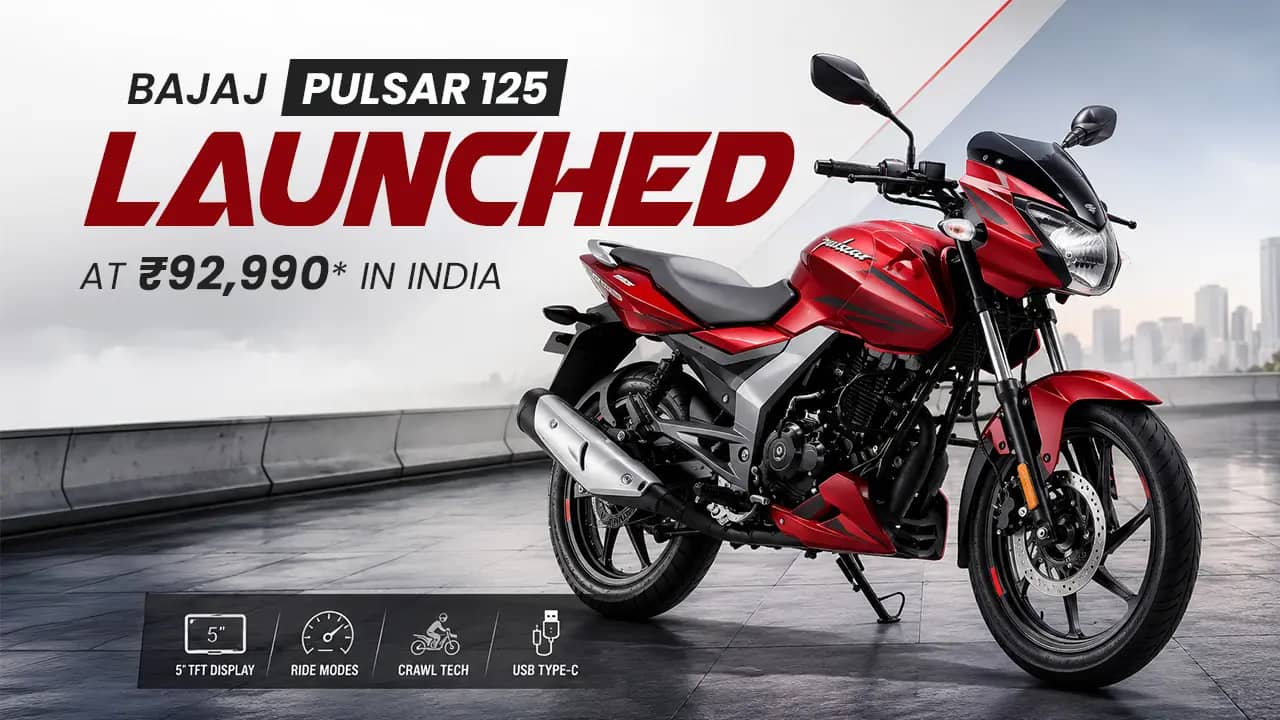
The new Bajaj Pulsar 125 and Pulsar 150 bring a major technology update to Bajaj’s popular commuter-performance motorcycles. Priced from ₹92,990 and ₹1.15 lakh respectively, both models now get revised engines, monoshock suspension and new connected features, while select variants add a 5-inch TFT display, riding modes, Google Maps navigation, USB Type-C charging and Crawl Tech.
Bajaj Pulsar 125 has been launched in India at ₹92,990 ex-showroom, while the new Pulsar 150 starts at ₹1,15,233 ex-showroom, giving two of Bajaj’s oldest motorcycles a much deeper update than a routine facelift. The launch on August 24, 2026, comes as the Pulsar brand marks 25 years, but the bigger story for buyers is underneath the familiar styling: revised engines, a new frame, monoshock suspension and considerably more technology.
That matters because the 125cc commuter-performance space has become far more competitive. Buyers now expect LED lighting, smartphone connectivity and useful everyday convenience even from sub-₹1 lakh motorcycles. Bajaj has responded by bringing features such as riding modes, Crawl Tech and a five-inch TFT with navigation to selected variants.
Bajaj Pulsar 125 and 150 price in India
The Pulsar 125 is available in four variants, starting at ₹92,990 and going up to ₹1,04,318 ex-showroom. The Pulsar 150 range starts at ₹1,15,233 and stretches to ₹1,23,187, depending on the braking and seat configuration.
For a Delhi buyer, registration, insurance and other charges will push the actual on-road figure substantially higher. A reasonable working estimate is around ₹1.08-1.12 lakh for the Pulsar 125 base and roughly ₹1.34-1.39 lakh for the higher Pulsar 150 variants, although the final amount will vary with insurance, registration and dealer charges. The ex-showroom number is therefore useful for comparison, but it is not the cheque amount a buyer should budget.
What do you get for the Pulsar 125’s price?
The new Pulsar 125 uses a 124.58cc single-cylinder engine paired with a five-speed gearbox. Published launch specifications put output at around 11.8 bhp at 8,000rpm and 11Nm at 6,000rpm, while Bajaj has concentrated heavily on making low-speed riding easier rather than simply chasing a bigger peak-power number.
One particularly relevant change is the new gearbox calibration. Bajaj says 85 per cent of available torque is accessible from 3,000rpm onwards, while deeper gear bevels are intended to improve tractability and reduce clutch work in lower gears. For riders dealing with Delhi, Mumbai or Bengaluru traffic every day, that matters more than a headline top-speed figure.
The motorcycle also moves from the earlier twin-shock arrangement to a monoshock rear suspension and uses a revised diamond-type frame. The base variant gets a coloured LCD, LED headlamp, Crawl Tech and monoshock, while higher versions add the more interesting electronics.
Crawl Tech deserves attention because it is designed specifically around slow-moving traffic. The system allows the bike to creep forward without continuous throttle input, reducing the amount of clutch and throttle juggling required in bumper-to-bumper conditions. That is the sort of feature that sounds unusual on paper but could become genuinely useful during a 45-minute commute.
The tech story is bigger than the price suggests
Move up the Pulsar 125 range and the equipment list changes dramatically. Selected variants get three ride modes — Road, Rain and Sport — a five-inch TFT display, LED indicators, hazard lamps, integrated starter generator and a standard USB Type-C port. The TFT brings smartphone functions, navigation and Google Maps mirroring into a motorcycle that remains close to the ₹1 lakh mark.
The important catch is variant selection. The ₹92,990 base motorcycle does not get the complete technology package, so buyers attracted by the TFT and riding modes should not assume that every Pulsar 125 carries them. The jump to the ₹99,291 STD Single Seat is ₹6,301, and that is where much of the desirable equipment arrives.
For many buyers, that makes the mid-spec motorcycle more interesting than the headline starting price. Spending another few thousand rupees gets you considerably more than cosmetic upgrades, particularly if navigation, smartphone connectivity and Type-C charging matter in daily use.
What about the Pulsar 150?
The Pulsar 150 follows the same basic formula but uses a 149.5cc single-cylinder engine producing about 13.8 bhp and 13.7Nm, with a five-speed gearbox.
Its three-variant line-up starts with the Single Disc at ₹1,15,233, followed by the Twin Disc Single Seat at ₹1,22,184 and Twin Disc Split Seat at ₹1,23,187. The Twin Disc versions add a rear disc brake and the five-inch TFT with Google Maps navigation, along with LED indicators, hazard lamps and ISG.
There is an interesting value calculation here. The move from the Single Disc to the Twin Disc Single Seat costs ₹6,951, yet brings several meaningful additions. The final jump to the split-seat version is only ₹1,003, so buyers who prefer the sportier seating arrangement have little financial reason to avoid it.
Pulsar 125 vs Hero Xtreme 125R: which makes more sense?
The closest alternative for the Pulsar 125 is the Hero Xtreme 125R, particularly for buyers who want a sporty-looking everyday 125. Hero's motorcycle uses a 124.7cc engine producing 11.4 bhp and 10.5Nm, has a monoshock and is officially rated at around 63kmpl under WMTC testing.
The Xtreme is lighter at around 136kg, while the new Pulsar's appeal is its broader technology package and stronger traditional Pulsar character. If outright fuel economy and a lighter motorcycle are the priorities, the Hero deserves a serious look. But if the buyer wants a 125cc motorcycle with a TFT, riding modes and Crawl Tech, the new Pulsar has the more unusual proposition.
The same logic changes slightly with the Pulsar 150. The TVS Apache RTR 160 4V costs more in some configurations but produces a substantially higher 17.55 PS and 14.73Nm from its 159.7cc engine. The Apache is therefore the stronger performance choice, while the Pulsar 150 makes more sense for someone who wants a familiar 150cc package with the new technology and a more relaxed everyday character.
Mileage and running cost: what will it cost to ride?
Bajaj has not positioned these motorcycles purely around headline mileage, so real-world consumption will depend heavily on traffic, riding style and the selected mode. A sensible working expectation for the Pulsar 125 is around 50-55kmpl, while the Pulsar 150 should broadly land around 43-48kmpl in mixed Indian riding rather than matching laboratory figures in every situation.
At a petrol price of roughly ₹103 per litre, a rider covering 1,000km a month at 52kmpl would spend about ₹1,981 on fuel with the Pulsar 125. At 45kmpl, the Pulsar 150 would cost around ₹2,289 per month for the same distance. That ₹300-plus monthly difference is not huge, but over 20,000km it becomes noticeable — especially for a commuter who rides every day.
Financing also makes the variant gap worth considering. For example, assuming ₹20,000 down payment, a loan rate of 11.99% for 36 months would put the approximate EMI at ₹2,424 for the ₹92,990 Pulsar 125 base before accounting for any additional on-road costs. The same simplified calculation on the ₹1,15,233 Pulsar 150 comes to about ₹3,163 per month. Actual Drivio financing can vary by customer profile, down payment, tenure and applicable charges, so these figures are useful as a budgeting reference rather than a quotation.
Should you buy the new Pulsar 125 or wait?
The new Pulsar 125 is a strong choice for riders who want a conventional petrol motorcycle but do not want to settle for an old-school commuter specification. The ₹92,990 starting price is attractive, but the ₹99,291 mid variant looks like the smarter buy if the TFT, ride modes, connectivity and additional equipment are important to you. For a daily urban rider, Crawl Tech and the improved low-speed tractability may prove more useful than the headline electronics.
The Pulsar 150 deserves a different verdict. It is no longer the obvious performance leader in this price band, with motorcycles such as the Apache RTR 160 4V offering considerably more power. But its combination of 150cc performance, familiar ergonomics, improved chassis hardware and modern connected technology makes it a sensible middle ground.
For buyers replacing an older commuter, the Pulsar 125 mid variant is the version I'd pick, while riders regularly carrying a pillion or doing longer highway runs should spend the extra on the Pulsar 150. If you're ready to make the decision, check the on-road price and EMI for the Bajaj Pulsar 125 in your city on Drivio.
Bajaj has updated the Pulsar 125 and Pulsar 150 with more technology while keeping them within reach of everyday Indian riders. The Pulsar 125 remains the more affordable option for city commuting, while the Pulsar 150 offers stronger performance and additional equipment at a higher price. With rivals such as the Hero Xtreme 125R and TVS Apache RTR 160 4V in the picture, the new Pulsars make a stronger case through their combination of familiar styling, updated hardware and modern features.