Hero Splendor Plus in 2026: Who Should Buy It and Who Should Skip
Overview
The Hero Splendor Plus starts at ₹77,777 ex-showroom in Delhi, but is it right for every commuter? This guide breaks down who should buy India's default 100cc commuter and who should skip it. It covers the Delhi on-road price of ₹87,000 to ₹93,000, a 60-month EMI of about ₹1,353, and a monthly fuel bill near ₹1,585. It also weighs practical strengths, real trade-offs like drum brakes and modest highway pace, and rivals including the Honda Shine 100, Bajaj Platina 100, TVS Star City+ and TVS Raider 125.
The Hero Splendor Plus starts at ₹77,777 ex-showroom in Delhi this October, and that one number decides who should walk into the showroom and who should keep walking. India's default 100cc commuter still returns 65 to 72 kmpl in real traffic. It now costs about ₹12,000 more than a Honda Shine 100, though, and it asks you to live without a front disc brake or a phone charger. How you ride decides whether that premium is money well spent.
Who Should Buy the Hero Splendor Plus in 2026?
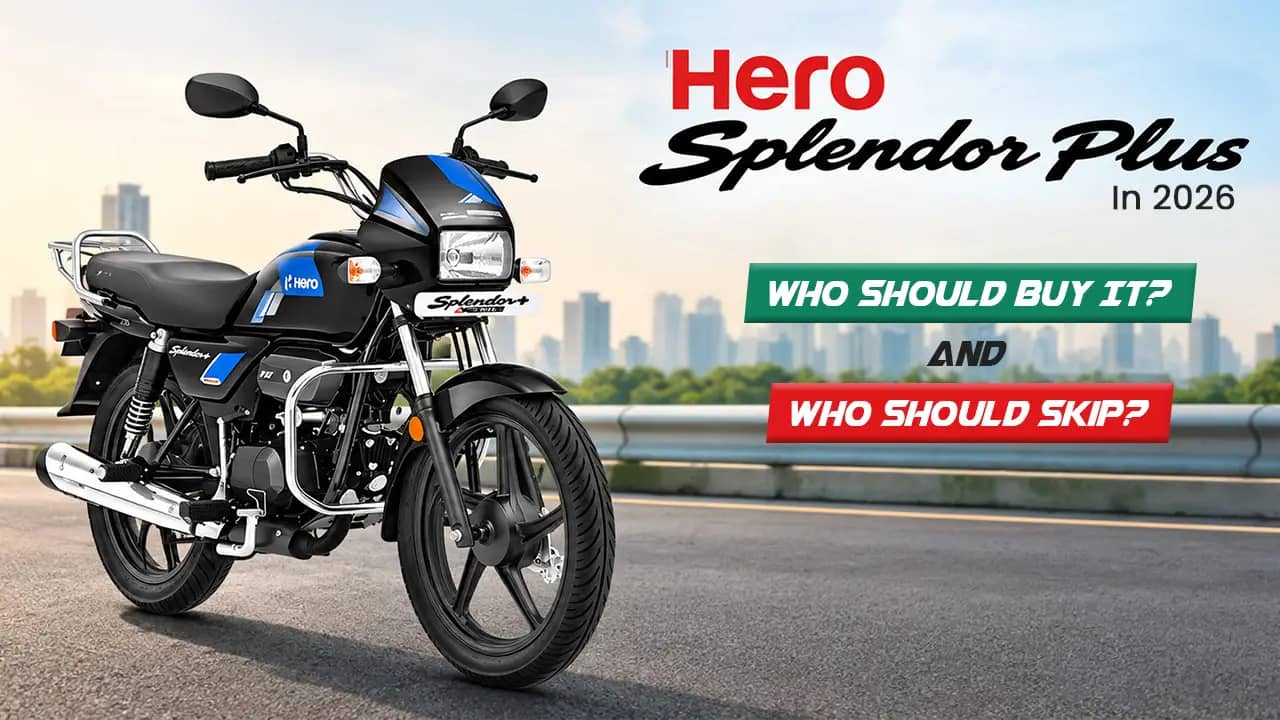
Think of the rider who covers 30 to 40 km a day on mixed city and town roads, keeps a bike for six or seven years and wants resale to be someone else's problem. The Splendor+ was built for that person. Its 97.2cc engine makes 7.91 bhp at 8,000 rpm and 8.05 Nm at 6,000 rpm, which looks feeble on paper. On the road, the power delivery is tuned for 20 to 40 km/h crawling, and the 4-speed gearbox lets a 112 kg bike pull out of a jam without drama. First-time buyers fit this profile, as do owners replacing a ten-year-old Splendor and anyone living in a town where the nearest Hero workshop is five minutes away. Delivery riders who own their bikes should pay attention too.
Splendor Plus On-Road Price, EMI and Monthly Fuel Cost
The Drum Brake variant is ₹77,777 ex-showroom in Delhi. The i3S with idle start-stop sits around ₹78,900, and the 125 Million Edition is about ₹80,500. Add RTO and insurance, and the on-road price in Delhi lands between roughly ₹87,000 and ₹93,000, depending on the insurance quote and whatever add-ons the dealer slips in. Push back on those.
Take the base bike on a 20% down payment and a 60-month loan at 11%. You pay about ₹15,555 upfront, the EMI comes to roughly ₹1,353, and you hand over around ₹19,000 in interest by the end.
Fuel is the other half of the bill. At ₹103 a litre and a realistic 65 kmpl, 1,000 km a month costs about ₹1,585, or ₹1.58 per km. A 125cc commuter managing 50 kmpl would burn ₹2,060 over the same distance. That is nearly ₹475 saved every month, about ₹5,700 a year. Stack EMI and petrol together and you are under ₹3,000 a month, before insurance renewal and service.
Practical Strengths That Don't Show Up on a Spec Sheet
The 9.8-litre tank and a 65 kmpl average add up to roughly 600 km between fill-ups, so a rider doing 40 km a day visits the pump every two weeks. The 785 mm seat lets most adults flat-foot at a signal, and 112 kg is light enough that a parking-lot wobble never turns into a fall.
Parts are the real advantage. Every Hero outlet, and most roadside mechanics, can fix a Splendor from memory, which keeps labour bills low. Budget about ₹3,500 to ₹4,500 for servicing and consumables across the first 10,000 km. That is a likely figure rather than a quoted one, since workshop rates vary by city. Resale is the quiet payoff. A five-year-old Splendor sells faster than almost anything else in the used market, and that money comes straight back when you upgrade.
The Trade-Offs Nobody Mentions at the Dealership
Both ends get drum brakes, and the standard bike has no disc option at all. Wet-road braking is where you feel it. The twin rear shocks are tuned soft for potholes, so the bike floats a little on fast, uneven stretches. A claimed top speed of about 87 km/h makes the highway something to survive rather than enjoy. Acceleration is unhurried by design.
The standard bike also has an analogue console with no phone charger. The Xtec adds a digital cluster and Bluetooth from around ₹81,000, but at that money you are edging toward 125cc territory.
Then there is the premium. The Hero Splendor Plus makes the same 8.05 Nm as the Honda Shine 100 and costs about ₹12,000 more. That gap buys Hero's service network, spares availability and resale strength. It does not buy extra performance.
Who Should Skip It, and What to Buy Instead
Skip the Splendor+ if you ride highways regularly, carry a pillion and luggage every day, or weigh well over 85 kg. The engine will work hard, and you will feel it. Skip it too if sticker price is your only filter. The Honda Shine 100 starts around ₹65,400 with 99.7cc, 7.5 bhp and the same torque. The Bajaj Platina 100, at roughly ₹67,000, carries an 11-litre tank and a softer reputation on broken roads.
Buyers who want more features for similar money should look at the TVS Star City+, priced between ₹72,500 and ₹75,200. Anyone doing 50 km or more a day should step up to a 125cc such as the TVS Raider 125, which Drivio has covered. You accept a higher fuel bill in return for better highway manners.
The Verdict
Pick the Splendor+ if you want a cheap-to-run, hard-to-kill commuter and you value resale and a workshop on every corner over speed and kit. The Shine 100 or Platina makes more sense if rupees today matter more than rupees in six years. A 125 is the better call if your route includes a highway. Dealer-added extras can shift the final bill by thousands, so price your exact variant before you commit. Check the on-road price and EMI for the Hero Splendor Plus in your city on Drivio.
The Splendor+ suits riders covering 30 to 40 km daily who want low running costs, easy servicing and strong resale. At 65 kmpl, 1,000 km costs about ₹1,585 in petrol at ₹103 a litre. Its 97.2cc engine makes 7.91 bhp and 8.05 Nm, enough for city traffic but not highways. Drum brakes and no phone charger are the compromises. It costs ₹12,000 more than the Honda Shine 100 for the same torque. Highway riders should consider a 125cc, while budget buyers should look at the Shine 100 or Platina.