EV vs Petrol Scooter Maintenance: Battery Life, Repairs and Ownership Costs
Overview
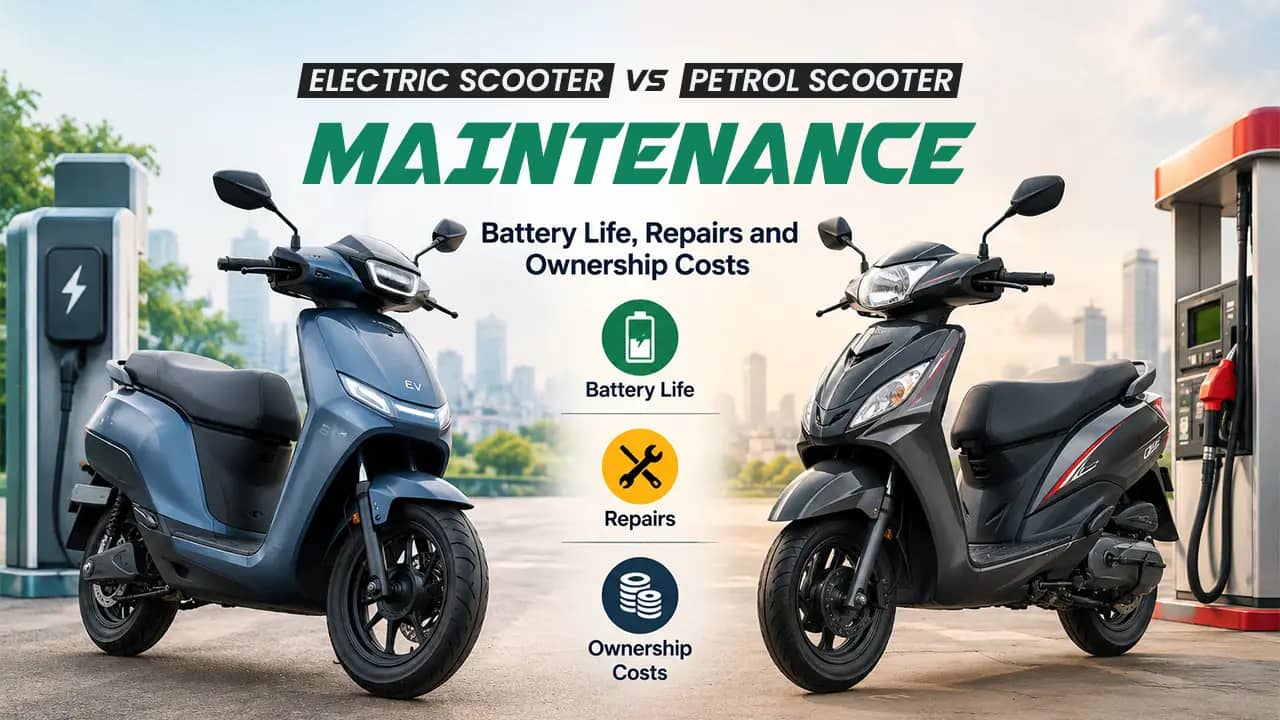
Maintenance is often where the long-term difference between petrol and electric scooters becomes visible. Electric scooters usually need less routine mechanical servicing, but major battery and electronic repairs can be expensive. This guide explains the maintenance cycle, battery-life factors, warranty questions and repair risks buyers should consider before choosing either technology.
A scooter is not a one-time purchase. It requires periodic servicing, consumables, inspections, tyres, brakes, insurance and occasional repairs throughout its life. Focusing only on the purchase price can therefore produce an incomplete comparison.
Routine maintenance: the electric advantage
An electric drivetrain has fewer moving parts than an internal-combustion powertrain. Routine service can therefore be simpler. Common jobs include brake and tyre checks, suspension inspection, software updates, electrical-system diagnostics and general condition checks.
A petrol scooter may need engine-oil changes, air-filter servicing, spark-plug inspection, engine tuning and other engine-related work. These tasks accumulate over time and become part of the ownership budget.
As an illustrative planning range, annual routine maintenance may be around ₹1,000–₹1,500 for an electric scooter versus roughly ₹4,500–₹6,000 for a petrol scooter. These figures should be treated as budgeting examples rather than fixed service prices.
The battery is the key long-term EV question
For an electric scooter, the battery is both the energy source and one of the most valuable components. Battery health is commonly discussed using state of health, or SOH, which represents the remaining usable capacity relative to a reference condition.
Battery degradation is normal. The important question is how quickly useful capacity declines and how the manufacturer handles that decline. Temperature management, cell balancing, charging controls, chemistry, riding patterns and software all influence battery longevity.
A buyer should therefore ask two separate questions: how long the battery is expected to remain useful, and what the warranty promises if capacity falls below a stated threshold.
What battery health means in everyday use
Imagine a battery that originally provided enough usable energy for a certain daily route. As it ages, its available capacity may decline. The scooter may still function normally, but the practical range can become lower than when new.
This does not automatically mean the battery needs immediate replacement. A healthy ageing process can leave the scooter useful for many years, especially when the remaining range still covers normal commuting needs.
For buyers, battery health matters because it affects three things at once: usable range, replacement risk and resale value.
Charging behaviour and battery life
Battery longevity depends on more than the number of charging sessions. Frequent exposure to high temperatures, extreme charge levels, heavy loads and aggressive use can influence degradation, while a well-managed charging system can reduce stress on the battery.
For everyday ownership, the simplest approach is to follow the vehicle manufacturer’s charging guidance, avoid unnecessary heat exposure where practical, and use the recommended charging equipment and settings.
Fast charging is convenient, especially for longer trips, but buyers should evaluate it as part of the scooter’s total charging strategy rather than assuming that maximum charging speed is always the most important feature.
Major EV repairs can be expensive
The lower routine maintenance requirement of an EV does not mean every repair is cheap. Battery packs, motors, controllers, displays and other power-electronic components can be expensive because they are sophisticated and relatively high-value parts.
An illustrative example might put a battery replacement in the ₹50,000–₹60,000 range, a motor replacement around ₹10,000–₹15,000 and a display or dashboard replacement around ₹7,000–₹8,000. Actual costs vary by vehicle, part, labour, warranty status and market pricing.
This is why a realistic EV ownership analysis must separate routine maintenance from low-frequency, high-cost failures.
Warranty can reduce major-repair risk
Warranty coverage can materially change the economics of an electric scooter. The most important items to inspect are battery warranty period, kilometre limits, state-of-health guarantees, exclusions, and coverage for the motor, controller, display and other electrical components.
A long battery warranty is especially valuable because it protects against one of the most expensive potential ownership events. However, warranty wording matters more than the headline number. Buyers should read the exact conditions, exclusions and required service procedures.
Extended warranty packages can also differ in what they cover, so a buyer should not assume that every electrical component remains protected for the same duration.
Petrol scooters have their own long-term maintenance curve
Petrol scooters are based on mature mechanical systems, but the number of serviceable engine and drivetrain components means wear accumulates over time. Older vehicles may need more frequent attention to consumables, seals, belts, filters, plugs and engine-related components.
Fuel-system and emissions-related components can also become part of the maintenance picture as a vehicle ages. For owners keeping a scooter for many years, the annual service budget should gradually account for wear rather than assuming the first-year cost will remain unchanged.
How to compare maintenance before you buy
Start with the official service schedule and expected replacement items. Then estimate annual maintenance for your intended ownership period. Separate routine service from tyres, brakes and other wear items, and separately model possible major repairs.
For an electric scooter, add battery warranty and battery health to the checklist. For a petrol scooter, consider the engine service schedule and the effect of vehicle age on maintenance frequency.
The best comparison is not “Which has zero maintenance?” Neither does. The useful question is “Which maintenance pattern matches my budget, annual kilometres and risk tolerance?”
Conclusion
Electric scooters generally have a simpler routine maintenance schedule, but their high-value electrical components can create larger individual repair bills outside warranty. Petrol scooters have more recurring mechanical service requirements and can become more maintenance-intensive as they age. For buyers, the smartest comparison is to separate routine maintenance from major repairs, then examine battery warranty, service schedules, expected annual kilometres and holding period. That approach gives a more realistic view of long-term ownership than comparing service charges alone by itself.
Electric scooters generally have lower routine maintenance costs due to fewer moving parts, while petrol scooters require regular engine servicing and consumable replacements. However, EV battery, motor and electronic repairs can be expensive outside warranty. Buyers should compare service schedules, battery health, warranty coverage, expected repair costs and ownership duration to estimate long-term expenses and choose the scooter that best suits their budget.