5-Year Total Cost of Ownership: EV vs Petrol Scooter in India
Overview
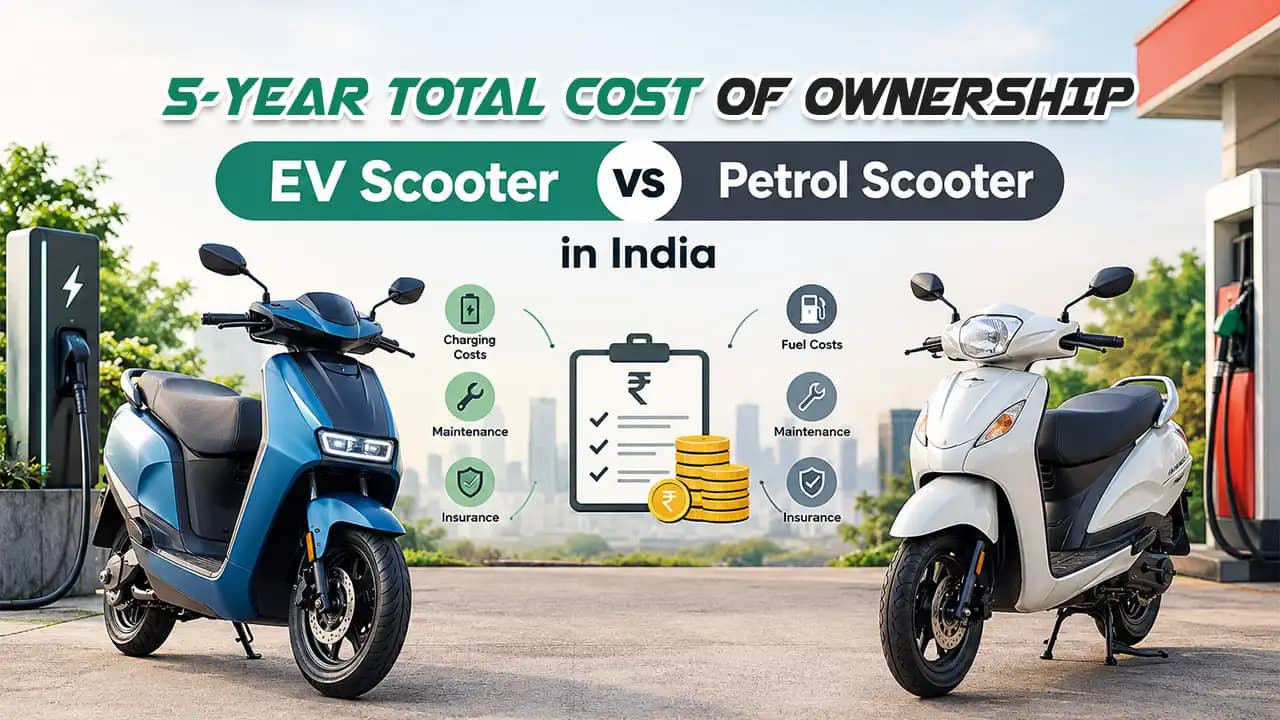
The cheapest scooter to buy is not always the cheapest scooter to own. A five-year total cost of ownership calculation combines purchase price, fuel or electricity, maintenance, insurance, repairs and resale value. This worked example shows how the numbers can change for a high-mileage rider and why annual kilometres matter so much.
Total Cost of Ownership, or TCO, is a simple way to measure what a vehicle really costs over a defined period. Instead of looking only at the purchase price, it adds the recurring expenses of using and maintaining the vehicle and then subtracts the value recovered when the vehicle is sold.
The five-year example
To make the calculation easy to follow, consider a rider who travels about 33 km every day for five years. That produces roughly 12,000 km of riding per year, or about 60,000 km over the full ownership period.
For illustration, assume a petrol scooter costs ₹92,000 upfront and an electric scooter costs ₹1.30 lakh. The figures are examples for demonstrating the method, not recommendations or fixed market prices.
The important point is that the electric scooter starts more expensive. The rest of the TCO calculation tests whether lower operating costs can recover that initial gap.
Step 1: Calculate annual distance
Daily distance × 365 gives annual distance. At 33 km per day, the rider covers 12,045 km in a year. Rounded for planning, that is approximately 12,000 km annually.
Over five years, the total distance becomes about 60,000 km. This is a relatively high usage pattern compared with a light-use rider, which is important because operating-cost savings increase with kilometres travelled.
Step 2: Estimate energy cost
For the example, use ₹2.09 per km for petrol running cost and ₹0.23 per km for electricity. Again, these are illustrative assumptions that can be replaced with current local prices and your scooter’s real efficiency.
Petrol: 12,000 km × ₹2.09 ≈ ₹25,000 per year, or about ₹1.25 lakh over five years.
Electricity: 12,000 km × ₹0.23 ≈ ₹2,760 per year, or about ₹13,800 over five years.
The difference is approximately ₹1.11 lakh over five years in this example. That single variable is large enough to offset much of the higher purchase price of an electric scooter.
Step 3: Add routine maintenance
Assume average annual routine maintenance of ₹5,000 for the petrol scooter and ₹1,250 for the electric scooter.
Over five years, petrol maintenance becomes ₹25,000, while electric-scooter maintenance becomes ₹6,250. The difference is ₹18,750 in favour of the electric scooter under these assumptions.
Real maintenance costs will depend on service plans, tyres, brakes, usage conditions, workshop pricing and vehicle age. The model should therefore be updated whenever you have actual service estimates.
Step 4: Add insurance
Insurance must be included because it is a recurring cash cost. For this illustration, assume ₹3,500 per year for the petrol scooter and ₹5,000 per year for the electric scooter.
That gives five-year insurance costs of ₹17,500 and ₹25,000 respectively. The electric scooter therefore carries a higher assumed insurance cost in this scenario, partially offsetting its operating-cost advantage.
For a real purchase decision, use quotes for the exact vehicle, city and policy coverage rather than relying on generic averages.
Step 5: Add purchase price
The petrol scooter begins at ₹92,000 in our illustration. The electric scooter begins at ₹1.30 lakh. This creates an initial price difference of ₹38,000 in favour of petrol.
This is why a purchase-price-only comparison can be misleading. The electric scooter starts behind, but it has lower energy and routine maintenance costs throughout the five-year period.
Step 6: Subtract resale value
Resale value is effectively a recovery of part of your original investment, so it should be subtracted from total ownership cost.
For the illustration, assume the petrol scooter retains about 50% of its original value after five years. That gives a resale value of about ₹46,000.
For the electric scooter, assume a 40% retained value. On a ₹1.30 lakh purchase, that is about ₹52,000.
These percentages are only planning assumptions. Real resale depends on condition, battery health, remaining warranty, market demand, model age and local buyer preferences.
The final five-year TCO example
Petrol scooter: ₹92,000 purchase + ₹1,25,000 fuel + ₹25,000 maintenance + ₹17,500 insurance = ₹2,59,500. Subtract ₹46,000 resale value and the five-year TCO is about ₹2.14 lakh.
Electric scooter: ₹1,30,000 purchase + ₹13,800 electricity + ₹6,250 maintenance + ₹25,000 insurance = ₹1,75,050. Subtract ₹52,000 resale value and the five-year TCO is about ₹1.23 lakh.
Under these assumptions, the electric scooter costs about ₹91,000 less over five years. The exact result changes immediately if the purchase price, energy rate, annual distance, insurance, maintenance or resale assumption changes.
Why annual kilometres change the answer
TCO is highly sensitive to usage. A rider covering 4,000 km a year does not capture the same energy savings as someone covering 12,000 km a year. The higher the annual distance, the faster a lower running cost can offset a higher upfront price.
This is why commuting patterns are more important than a generic “EV is cheaper” or “petrol is cheaper” statement. A rider should calculate their own annual kilometres before deciding.
A simple TCO checklist for your own scooter
Use the actual on-road purchase price, not just the ex-showroom price. Add realistic annual kilometres, current fuel or electricity cost, scheduled maintenance, tyre and brake wear, insurance and any expected out-of-warranty repairs. Finally, use a conservative resale estimate.
Run the same formula for both technologies using the same holding period and annual distance. The option with the lower TCO is not necessarily the one you should buy, but it gives you a much clearer financial baseline for the decision.
Conclusion
A five-year TCO model shows why a higher-priced electric scooter can still cost less to own than a petrol scooter. In the illustrative high-mileage example, energy and routine-maintenance savings more than offset the initial price premium. But TCO is personal: change the annual kilometres, local energy prices, insurance, maintenance or resale assumption and the answer can change. The best buying decision comes from calculating your own numbers rather than relying only on the showroom price or a general EV-versus-petrol claim.
Total Cost of Ownership (TCO) compares a scooter’s purchase price, energy expenses, maintenance, insurance and resale value over a fixed period. In this illustrative five-year example covering 60,000 km, an electric scooter costs approximately ₹1.23 lakh to own, compared with ₹2.14 lakh for a petrol scooter. Actual savings depend on annual usage, local energy prices, repair costs and resale value.