Suzuki Access 125 vs Honda Activa 125: Price, Mileage and Running Costs Compared
Overview
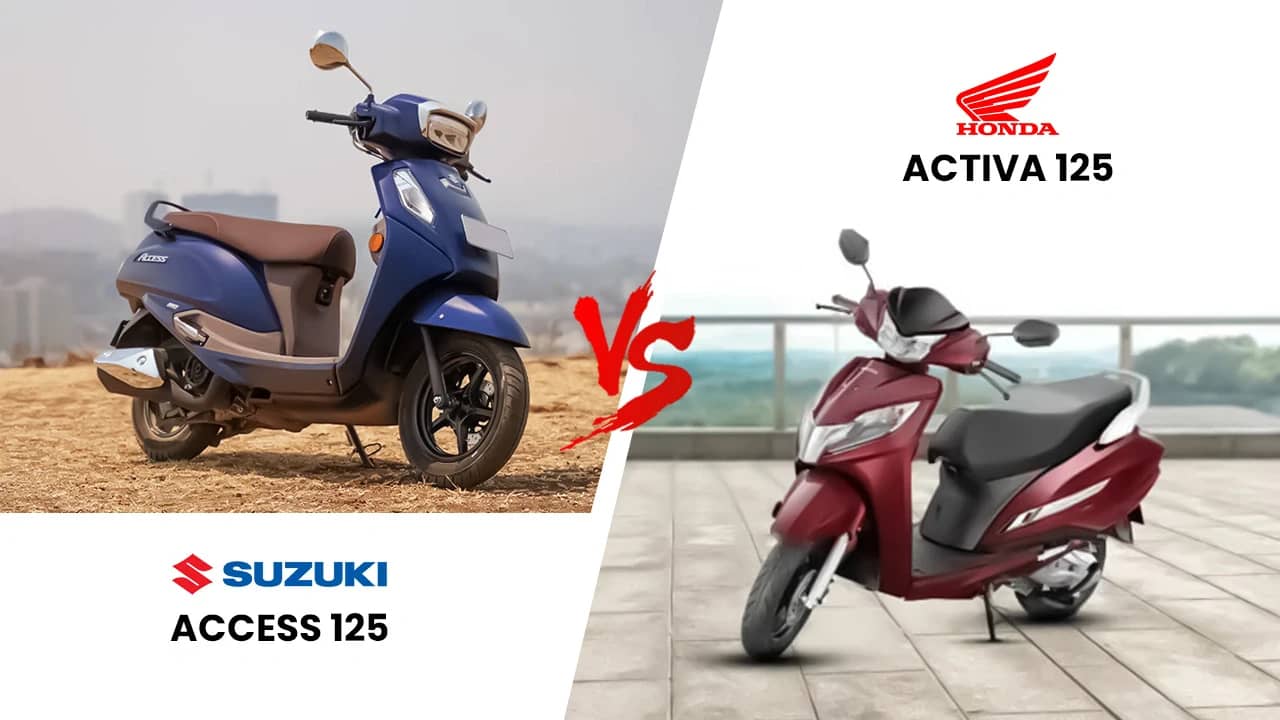
India’s two favourite 125cc scooters meet here. The Suzuki Access 125 starts near ₹83,000 ex-showroom, while the Honda Activa 125 begins around ₹91,000. This guide compares real prices, power, mileage, monthly fuel cost and EMI for city commuters, first-time buyers and families choosing a daily scooter.
The Suzuki Access 125 vs Honda Activa 125 decision in India comes down to roughly ₹8,000 at the showroom: the Access starts near ₹83,000 ex-showroom, while the Activa 125 begins around ₹91,000, going by recent Delhi listings. Both are 124cc automatics that handle the school run, the office commute and the odd highway stretch without fuss. With scooter prices still settling after the GST revision, that gap now decides more purchases than any spec sheet does.
Suzuki Access 125 vs Honda Activa 125 price in India: ex-showroom to on-road
Start with the Access. Delhi listings put the drum-brake Standard at about ₹82,185 and the disc-brake Special Edition near ₹87,827. The Ride Connect Edition, with Bluetooth connectivity, sits closer to ₹89,000, and the fully loaded trim climbs towards ₹1 lakh. The Activa 125 DLX is listed at roughly ₹91,000, with the keyless H-Smart variant reaching about ₹95,000. Prices differ between portals and cities, so treat these as a guide and confirm with a dealer.
On-road is where the real bill appears. Add road tax, registration, insurance and handling charges, and a base Access should land around ₹94,000 to ₹95,000 in Delhi. The Activa DLX is likely to cross ₹1.02 lakh. These are estimates, and Mumbai will run higher.
Here is how that plays out on a loan. Put down ₹15,000 on each scooter and borrow the rest at 10% for 36 months. The Access comes to an EMI of about ₹2,580, while the Activa works out near ₹2,810. That ₹230 monthly difference adds up to roughly ₹8,100 over the loan. Rates vary by lender and credit profile, so your own number will move.
Engine, power and the way they ride
Both use air-cooled, fuel-injected single-cylinder motors with CVT transmissions, so the numbers sit close together. The Access makes around 8.6 PS and 10.2 Nm from 124cc. The Activa’s 123.92cc unit is rated at 6.2 kW, which is about 8.4 PS, with a slightly stronger 10.5 Nm.
Weight changes the story. The Access is listed at 103 kg and the Activa at 109 kg. That 6 kg gap is why the Suzuki feels livelier pulling away from a red light, particularly with a pillion on board. Honda’s motor counters with a quieter, smoother hum at a steady 50-60 km/h, which suits long, flowing commutes better than stop-start Delhi traffic.
Rivals deserve a mention before you sign anything. The TVS Jupiter 125 and Honda Dio 125, both covered earlier on Drivio, are worth a test ride if neither of these two quite fits.
Mileage and monthly fuel cost at ₹103 a litre
Suzuki’s open-road figures point to 50-53 kmpl for the Access. City riding cuts that, and a realistic range is 45-50 kmpl. The Activa tends to return 42-48 kmpl in similar conditions. Those are likely real-world ranges, not certified numbers.
The ₹143 monthly gap comes to roughly ₹1,700 a year. It helps the Access, but it will not repay the price difference quickly on its own. The Activa’s larger tank cancels most of the mileage gap: both scooters should manage about 240 km between fill-ups.
Storage, features and daily usability
Space is the Access’s quiet strength. Its under-seat compartment is around 22 litres, enough for a full-face helmet and a laptop bag, while the Activa’s is closer to 18 litres. If you carry groceries or a school bag daily, you will feel that.
Features split by variant. The Ride Connect Edition adds Bluetooth pairing with call and message alerts, a feature the Activa DLX does not match. Honda answers with H-Smart, which gives you a smart key, a find-my-scooter function and one-touch unlocking. Both get LED headlamps. Pick based on which gadget you will genuinely use: navigation prompts on the handlebar, or leaving the key in your pocket.
Service cost, resale and the Honda network
Honda’s reach is the Activa’s strongest argument. Its sales numbers are enormous, and in March 2026 the Activa family sold close to 2.6 lakh units against 72,658 Access scooters, according to BikeDekho. In practical terms, that means a service centre in nearly every district and parts almost anywhere.
Servicing costs are close. Over the first 10,000 km, expect roughly ₹3,500 to ₹5,000 for routine services on either scooter, though Honda’s parts are generally the cheaper to replace. Resale is where the Activa pulls ahead. A three-year-old Activa typically sells faster and for more than a comparable Access, and that is worth weighing if you change scooters often.
Access 125 or Activa 125: which should you buy?
In the Suzuki Access 125 vs Honda Activa 125 contest, the Access wins for most Indian buyers. It costs less on the road, has more storage, is lighter, and its fuel bill is a little lower. Nothing in daily riding punishes you for saving that money.
The Activa makes sense for a narrower group: buyers in smaller towns where Honda service is the safer bet, riders who plan to sell in three to four years, and anyone who wants keyless convenience.
Whichever way you lean, check the on-road price and EMI for the Suzuki Access 125 in your city on Drivio, because a ₹8,000 gap can shrink or grow once your state’s road tax is added.
Pick the Access if you want the lower bill: roughly ₹8,000 less upfront, about 22 litres of under-seat storage and a fuel cost near ₹2,150 a month at 1,000 km. Choose the Activa only if resale value, Honda’s wider service reach or a keyless H-Smart start matter more than that saving. For most budget-minded riders, the Suzuki wins.