Pulsar 125 Price in India 2026: EMI, Loan, Mileage and Ownership Cost
Overview
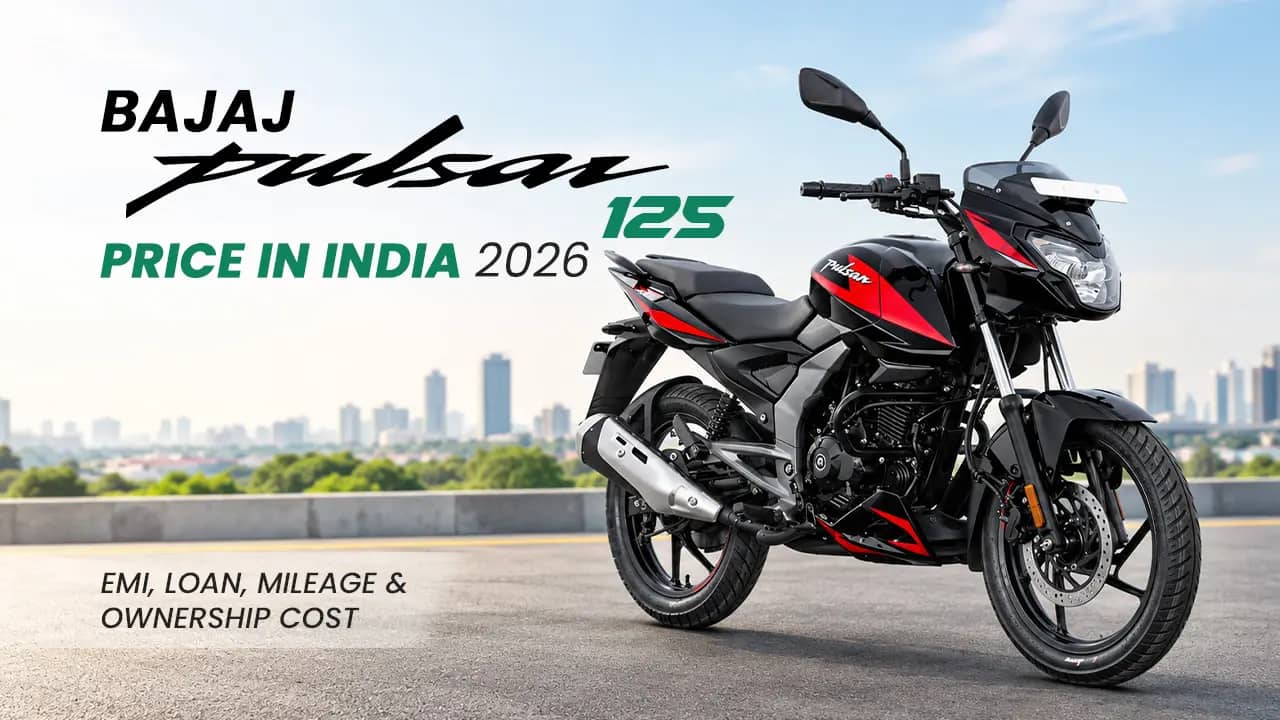
The Pulsar 125 is a 125cc sporty commuter positioned around a familiar Pulsar idea rebuilt as a modern 125cc commuter with far more technology than the old Classic platform. At the 22 September 2026 data checkpoint, the recent Delhi ex-showroom reference used here is ₹92,990, while the recent Delhi on-road reference is ₹1,08,905. Its status is important: Current, but the model changed substantially on 24 August 2026. The new-generation Pulsar 125 uses a new frame, engine/gearbox package and monoshock. Older 2026 twin-shock specifications should not be presented as the current bike. This guide connects price with loan structure, running cost, real use, service and alternatives rather than treating EMI as the entire purchase decision. [INTERNAL LINK: Bajaj brand page] gives the wider Bajaj lineup context, while [INTERNAL LINK: EMI guide] can support a live repayment calculation.
A useful buying guide starts with the invoice, not the brochure headline. At the 28 September 2026 data checkpoint, the recent Delhi ex-showroom reference used in this guide is ₹92,990. The recent Delhi on-road reference is ₹1,08,905. The difference represents items such as registration, road tax, insurance and other applicable charges, not extra engine or equipment value. Current, but the model changed substantially on 24 August 2026. The new-generation Pulsar 125 uses a new frame, engine/gearbox package and monoshock. Older 2026 twin-shock specifications should not be presented as the current bike. Because manufacturer pages, dealer systems and aggregators can update at different times, the final editorial check should use a same-day written quotation for the exact variant.
Pulsar 125 Variants and Price
Variant availability matters because seat layout, brakes, suspension, console and connected features can change the value of the loan. The table below uses only prices that were sufficiently clear at the data checkpoint and explicitly marks items that should be refreshed rather than inventing a figure.
Pulsar 125 On-Road Price
The Pulsar 125 on-road price is city-specific. Delhi’s recent reference of ₹1,08,905 is useful for an EMI illustration, but it is not an all-India price. Registration slabs, road tax, insurance premium, smart-card or hypothecation charges and optional dealer accessories can change the invoice. Ask for an itemised quotation showing ex-showroom price, statutory charges, insurance, compulsory charges if any and optional accessories separately. If a dealer quotes a low headline price but adds bundled accessories or an expensive insurance policy, compare the final payable amount with another authorised outlet before paying a booking amount.
Pulsar 125 Loan and EMI
A smaller EMI can come from a larger down payment, a longer tenure or a lower interest rate, and those three routes do not have the same total cost. Using the recent Delhi on-road reference of ₹1,08,905, an illustrative 20% contribution is about ₹21,781, leaving roughly ₹87,124 financed. At an illustrative 11% annual reducing-balance rate for 48 months, the EMI works out to about ₹2,252 per month and down payment plus scheduled EMIs total roughly ₹1,29,866, before processing fees or add-on products. This is an affordability example, not a lender offer. Actual rates, sanctioned amount, processing charges and tenure depend on the applicant and lender policy.
Illustration uses the recent Delhi on-road reference, 11% annual reducing-balance interest and excludes processing fee, accessories, loan-protection products and late charges. It is not a lender quotation.
Pulsar 125 Down Payment
On the same Delhi reference, moving from a 20% contribution of roughly ₹21,781 to 30% of roughly ₹32,672 cuts the illustrative financed amount by about ₹10,890. Under the same 48-month, 11% example, the EMI falls from about ₹2,252 to ₹1,970. A larger upfront payment therefore reduces both monthly pressure and interest paid, but it should not empty the buyer’s emergency savings. Keep money aside for first-year insurance differences, riding gear, periodic service and unexpected household expenses.
Pulsar 125 Interest Rate, Eligibility and Loan Tenure
A lender evaluating a Pulsar 125 loan commonly asks for identity and address proof, PAN, photographs and evidence of income or cash flow. Salaried applicants may be asked for salary slips and bank statements; self-employed applicants may need bank statements, tax returns or business proof. Credit history, existing EMIs, job or business stability, residence profile, requested tenure and loan-to-value ratio can affect approval and pricing. No article can promise approval or a fixed rate. Compare whether the quotation uses reducing-balance or flat-rate language, and check processing fee, late-payment terms, foreclosure/prepayment rules and any bundled insurance before signing. Shortening the example from 48 to 36 months raises the monthly payment from about ₹2,252 to ₹2,852, but the loan ends a year earlier and total interest falls. A longer tenure does the opposite. For buyers with variable income, a slightly lower EMI can protect cash flow, but stretching a small motorcycle loan too far can make the total finance cost disproportionate to the vehicle’s value. Choose the shortest tenure that remains comfortably payable even in a weaker income month.
Pulsar 125 Engine and Performance
The Pulsar 125 uses a 124.58cc single-cylinder, air/oil-cooled engine on the new-generation model producing about 11.8 bhp (roughly 12 PS) and 11.4 Nm, with a 5-speed manual. That hardware matches its role as a familiar Pulsar idea rebuilt as a modern 125cc commuter with far more technology than the old Classic platform. Peak figures do not describe the entire ride: low-rpm tractability, clutch feel, gearing and vibration at the buyer’s normal cruising speed matter more in daily ownership. During a test ride, use the motorcycle in slow second-gear traffic, a clean 40-80 km/h overtake and the highest regular road speed you expect to use. A motor that looks strong on paper may still feel tiring if heat, gearing or throttle calibration does not suit the route.
Pulsar 125 Mileage and Fuel Cost
The mileage reference used here is 50 kmpl (early owner/road-test reference for the new generation). Real economy changes with traffic, throttle use, tyre pressure, pillion/load, service condition and average speed. At a purely illustrative petrol price of ₹100 per litre, 1,000 km a month at 50 kmpl costs about ₹2,000 in fuel. That calculation is deliberately separated from current pump pricing so the page remains useful: replace ₹100 with the reader’s local petrol price. For ownership planning, a rider should use a conservative real-world mileage rather than the highest laboratory or promotional figure. Running-cost calculations should be kept separate from loan calculations so a small EMI does not hide an expensive daily-use pattern.
Pulsar 125 Ownership Cost: The Monthly Household View
For a household budget, combine the illustrative 48-month EMI of about ₹2,252 with a 1,000 km monthly energy/fuel estimate of about ₹2,000, then add a monthly reserve for insurance renewal, service and tyres. That combined mobility cost is more useful than comparing EMIs in isolation. A buyer should still be able to save after paying the vehicle. Keep several instalments as a cash buffer, and avoid using every rupee of savings as down payment simply to make the EMI look smaller. Affordability is strongest when the loan remains manageable even after an unexpected repair or a weaker income month.
Pulsar 125 vs Relevant Competitors
The useful comparison set is TVS Raider 125, Honda SP 125, Hero Xtreme 125R. The objective is not to name a universal winner: each alternative changes the balance among purchase price, power delivery, efficiency, comfort, technology, service access and resale familiarity. For the Pulsar 125, the decisive question is whether a familiar Pulsar idea rebuilt as a modern 125cc commuter with far more technology than the old Classic platform. Compare equivalent variants and equivalent insurance cover. A cheaper rival can become more expensive if the buyer finances more accessories; a costlier rival can make sense if it removes the need to upgrade again in a year. Test rides should follow the same route and, where possible, the same day.
Pulsar 125 for Daily Use
In daily use, the Pulsar 125 should be assessed for clutch effort, heat in slow traffic, turning radius, mirror width, low-rpm response, parking weight and fuel range. Its core fit is commuters and first-bike buyers who want Pulsar styling and connectivity while keeping fuel and finance costs below larger Pulsars. If most journeys are below 10 km in dense traffic, a simpler or lighter commuter can be financially smarter; if the route includes fast arterial roads, the extra performance and braking hardware can justify the payment. The right model is the one that fits the repeated Monday-to-Friday journey, not only the exciting weekend test ride.
Who Should Consider the Pulsar 125?
The clearest audience is commuters and first-bike buyers who want Pulsar styling and connectivity while keeping fuel and finance costs below larger Pulsars. The Pulsar 125 is less suitable when the buyer’s priorities sit outside its core brief. For example, a mileage-first commuter should not stretch for unused performance, while a regular tourer should not under-buy merely to save a small EMI. Its editorial angle is a familiar Pulsar idea rebuilt as a modern 125cc commuter with far more technology than the old Classic platform. Use that sentence as the decision filter: if the buyer would still choose the motorcycle without the badge or launch excitement, the product/finance fit is probably stronger. If the attraction is mainly cosmetic, compare the lower trim or a cheaper sibling first.
Pulsar 125: Purchase Cost vs Total Ownership Cost
Purchase cost is the amount required to put the Pulsar 125 on the road; ownership cost is what keeps it useful over the loan period. The first includes the down payment, financed principal, registration and insurance. The second includes interest, energy or fuel, scheduled maintenance, tyres, braking components, chain/sprocket where applicable, insurance renewals and the opportunity cost of accessories. For this model, the key ownership trade-off is This is one of the pages where publication date matters. Search results from early 2026 still describe the outgoing twin-shock Pulsar 125, while the late-August motorcycle is effectively a new generation. Drivio should keep the article anchored to the August 2026 machine and label any older price history clearly. A buyer should therefore create a 12-month budget, not just a delivery-day budget. If the yearly mobility cost feels uncomfortable on conservative mileage and a realistic finance rate, a lower variant or a different model is the safer decision even when a lender is willing to sanction more.
Delivery and First-Year Planning for the Pulsar 125
At delivery, inspect the Pulsar 125 in daylight and match the variant, colour, manufacturing month and identification numbers to the invoice and registration paperwork. Confirm both keys, tool kit, owner’s manual, warranty documents and any charger or accessory that is part of the chosen package. Record tyre pressures and odometer reading. During the first year, follow the running-in and service instructions in the current manual, keep all invoices and revisit the finance statement after the first few instalments to confirm there are no unexpected fees. Before an insurance renewal, compare equivalent IDV and add-on coverage rather than accepting an automatic quote. This mundane paperwork protects resale value and makes the real ownership cost easier to track.
Final Buying Perspective
The Pulsar 125 makes a coherent purchase when its core role - a familiar Pulsar idea rebuilt as a modern 125cc commuter with far more technology than the old Classic platform - matches the rider’s actual route and budget. The decision should combine the current invoice, a transparent loan calculation, conservative mileage, service access and consumable cost rather than one headline number. Use ₹1,08,905 as the recent Delhi reference at 22 September 2026, then refresh the exact city/variant quote before publication or booking.
The 2026 Bajaj Pulsar 125 gets a major generational update with a new frame, engine and monoshock setup. This guide covers its latest Delhi price, city-wise on-road costs, EMI examples, down payment, mileage and overall ownership expenses. The new 124.58cc engine produces about 11.8 bhp and 11.4 Nm, while the bike adds modern features including LED lighting, connected displays and navigation on higher trims. With a 50 kmpl early mileage reference, buyers can estimate monthly fuel costs alongside EMI, insurance, servicing and consumables before making a purchase decision.