Pulsar 150 vs Pulsar N160: Which Pulsar Makes More Sense in India?
Overview
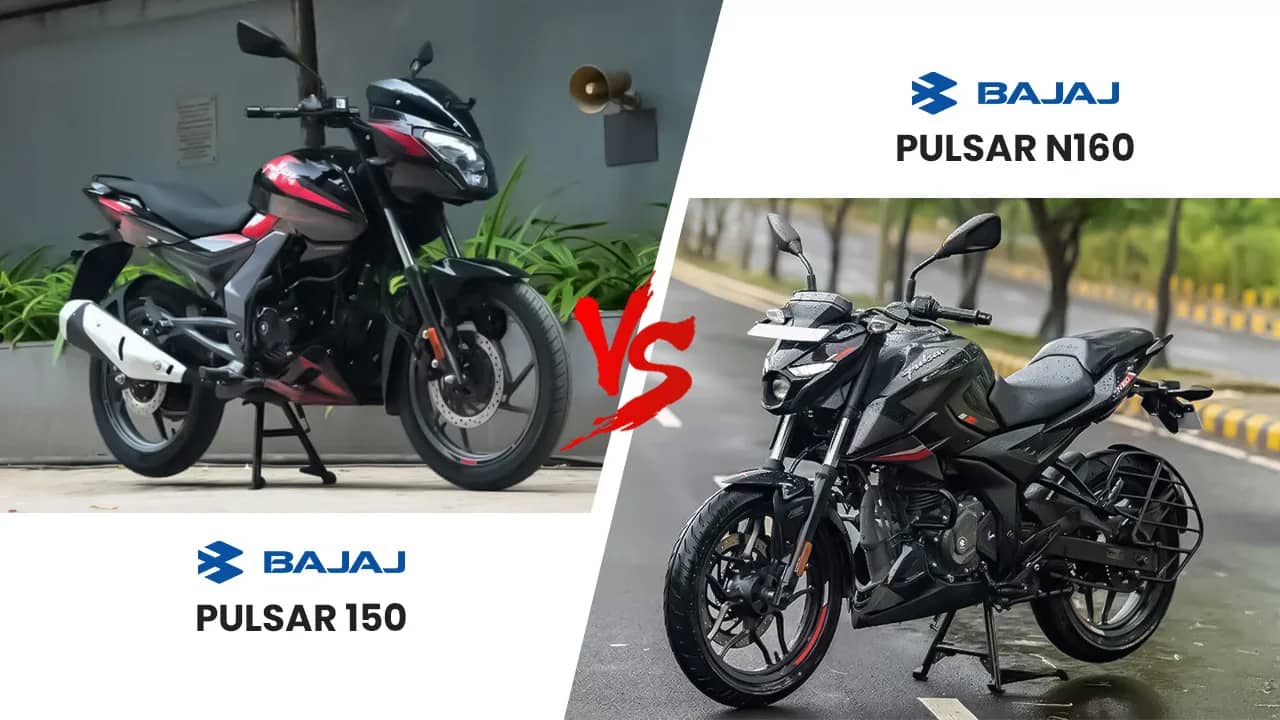
Bajaj’s refreshed Pulsar 150 starts at ₹1.15 lakh ex-showroom, while the new 4-valve Pulsar N160 S begins at ₹1.34 lakh. This India-focused comparison covers power, Delhi on-road cost, EMI and monthly fuel spend. It is written for riders stuck between the classic Pulsar commuter and the more modern N160.
The Pulsar 150 vs Pulsar N160 choice got harder in August 2026, when Bajaj launched an all-new Pulsar 150 at ₹1.15 lakh (ex-showroom, Delhi) and fitted a new 4-valve engine to the N160 S and SS at ₹1.34 lakh and ₹1.43 lakh. For Indian riders with ₹1.3 to ₹1.5 lakh to spend, the entry tickets now sit about ₹18,000 apart. The bikes are further apart than that number suggests.
Pulsar 150 vs Pulsar N160: Price, Power and On-Road Cost
Start with the money. The new Pulsar 150 price runs from ₹1,15,233 for the single-seat version to ₹1,23,187 for the twin-disc split-seat model. Add RTO and insurance and the Pulsar 150 on-road price in Delhi lands around ₹1.31 lakh for the base bike. The Pulsar N160 price starts at ₹1.34 lakh for the S (about ₹1.45 lakh on-road) and ₹1.43 lakh for the SS (about ₹1.55 lakh on-road). Mumbai buyers should expect a few thousand rupees more.
One trap to avoid. The older 2-valve N160 is still on sale from roughly ₹1.22 lakh, with 16 hp. Skip it. The new S costs about ₹11,000 more than the outgoing equivalent and brings 2.5 hp extra, an electronic throttle and four ride modes.
Power, Weight and Everyday Usability
The N160 S makes 18.5 PS at 9,500rpm and 14.5 Nm at 8,000rpm from its oil-cooled Pulsar N160 4V engine, an output Autocar India places in Yamaha MT-15 territory. The Pulsar 150 manages 14 PS at 8,500rpm and 13.7 Nm at 6,500rpm by Bajaj’s own numbers. Torque is nearly level. Power is not. Divide output by kerb weight and the N160 S makes about 122 PS per tonne against the 150’s 99, which is the gap between clearing a truck on the Delhi-Jaipur highway and sitting behind it.
The 150 hits back in the city. Bajaj says 85 per cent of its torque is available from 3,000rpm, it is about 9 kg lighter than the model it replaces, and Crawl Tech plus a start-stop system take the sting out of crawling traffic. It also gets a 5-inch TFT console with Google Maps. The N160 S, oddly, makes do with an LCD unit, so the cheaper bike has the better screen. Only the ₹1.43 lakh SS gets a TFT, along with traction control, adjustable levers and Bluetooth.
Hardware favours the N160. It runs 37mm USD forks and a 300mm front disc, with a 795mm seat and 165mm of ground clearance. The 150 relies on a new diamond tubular frame and a monoshock, which is plenty for 14 PS and not much beyond it.
Monthly Cost: EMI and Fuel at ₹103 a Litre
Take a standard finance assumption: 20 per cent down, 60 months, 11 per cent interest. On the Delhi on-road figures above, the Pulsar 150 EMI works out to about ₹2,280 a month after roughly ₹26,200 down. The N160 S needs about ₹29,000 down and ₹2,520 a month. The SS asks for roughly ₹31,000 down and ₹2,700.
Fuel is where it gets interesting. At ₹103 a litre and 1,000 km a month, the Pulsar 150 at 47 kmpl, which matches both its 47.5 kmpl claim and a first-ride test figure, burns about 21 litres, or ₹2,190. Bajaj has not published a confirmed ARAI number for the 4-valve engine, so treat 40 kmpl as the likely Pulsar N160 mileage. That means 25 litres and ₹2,575. Stack EMI and fuel and the N160 S costs roughly ₹630 more every month, close to ₹7,500 a year. Tank range tells the same story: 15 litres at 47 kmpl is about 700 km between fill-ups, while the N160’s 14-litre tank at 40 kmpl gives roughly 560 km.
Rivals frame the decision. The Honda Unicorn costs about the same as the Pulsar 150 and claims 50 kmpl, so a pure-mileage buyer has a cheaper-to-run alternative. On the other side, the TVS Apache RTR 160 4V, from about ₹1.20 lakh, is the N160’s natural rival and deserves a test ride. Drivio’s earlier reports on the 2026 Pulsar RS200 launch and the Pulsar 180’s discontinuation show where Bajaj is steering the range.
Which Pulsar Should You Buy Under ₹1.5 Lakh?
In the Pulsar 150 vs Pulsar N160 contest, the N160 S is the better buy for most people reading this. ₹630 a month buys a proper highway motorcycle: 4.5 PS more, USD forks, a larger front disc and ride modes that earn their keep in the rain. Pick the SS only if the TFT, traction control and connectivity matter enough to pay another ₹9,000 ex-showroom.
The Pulsar 150 is the right call in one situation. You ride 30 km a day through dense traffic, rarely cross 80 km/h and want the lowest running cost in the Pulsar family. A first-time buyer stepping up from a 100-110cc commuter will find 14 PS plenty, and the N160’s extra power rewards riders who already know what to do with it. Everyone else should stretch the budget.
Prices shift by city, insurer and tenure, so the only number that matters is yours. Check the on-road price and EMI for the Bajaj Pulsar N160 in your city on Drivio.
The N160 S takes this one on performance: 18.5 PS against 14 PS, plus ride modes and a bigger front disc. The 150 wins on running cost, roughly ₹2,190 a month in fuel at 1,000 km against about ₹2,575. Pick the 150 for tight-budget city commuting. Pick the N160 S if highways are part of your week or you want a bike with headroom.