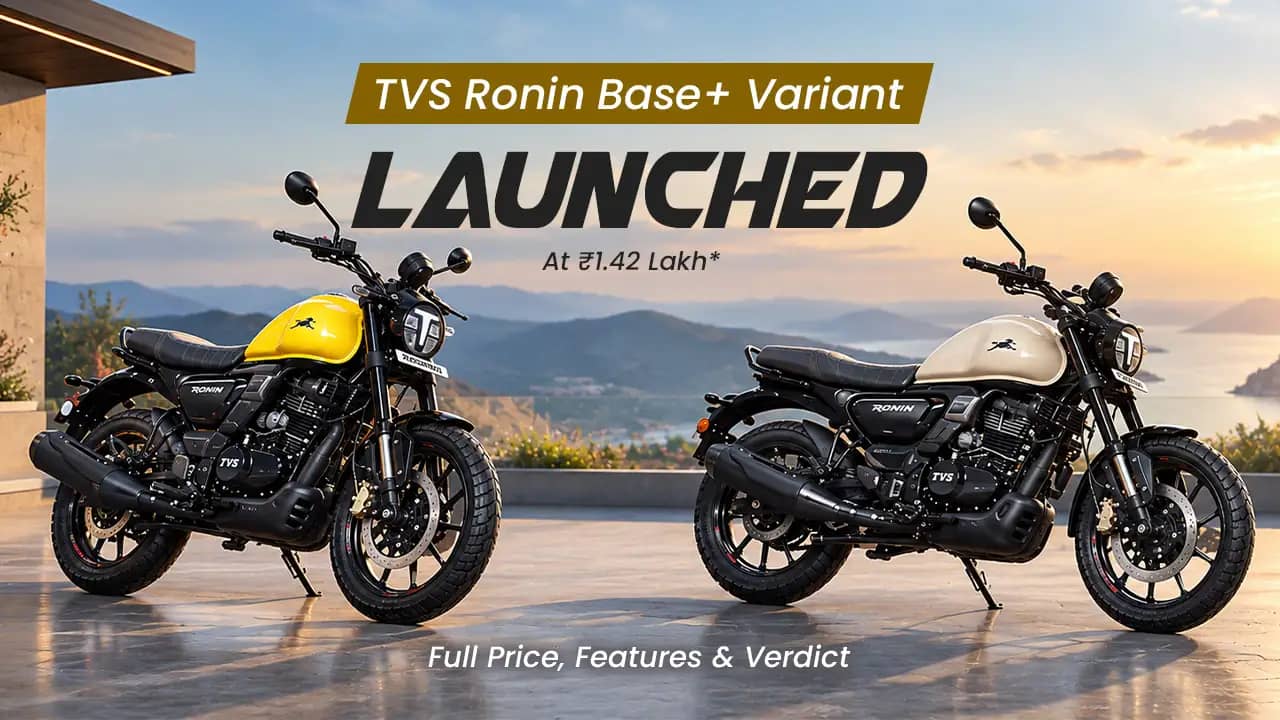
TVS Ronin Base+ Variant Launched at ₹1.42 Lakh — Full Price, Features and Verdict
Overview
TVS has updated the Ronin lineup ahead of the festive season with a new Base+ variant priced at ₹1,42,490, bringing dual-channel ABS to a more affordable trim for the first time. The Mid variant, now ₹1,51,540, adds a connected instrument cluster and Type-C charging port. The biggest change lands on the Top variant at ₹1,63,640, which gets a Traction Control System, a new premium seat, and fresh colour options. The 225.9cc engine remains unchanged across all trims, meaning this update is purely about safety and feature upgrades.
TVS Ronin Base+ variant has joined the lineup at ₹1,42,490 ex-showroom Delhi, and it changes the calculus for anyone shopping the neo-retro 225cc segment in India. TVS timed this update for the festive season, and it isn't a cosmetic refresh — dual-channel ABS, previously locked to the pricier Mid and Top trims, now sits on a bike priced under ₹1.43 lakh. That's the headline. The rest of the range moved too, and TVS used the opportunity to push real functional upgrades rather than new decals and call it a day.
What Changed Across the Ronin Range
Base+ gets dual-channel ABS and two new colour options — Sunlit Yellow and Desert Mirage — slotting between the outgoing Base and the Mid variant. Mid now costs ₹1,51,540 and picks up a connected instrument cluster along with a Type-C charging port, so riders finally get call and message alerts without stepping up to Top. The bigger jump is on Top, priced at ₹1,63,640: TVS has added a Traction Control System, a feature you'd normally expect on a bike costing considerably more. Top also gains the Type-C port, a new premium seat, and two fresh shades — Nimbus Grey and Midnight Blue.
None of this touches the engine. TVS left the 225.9cc single-cylinder motor untouched, which tells you this update is about closing feature gaps that buyers were actually complaining about — safety hardware on the cheaper trims, connectivity that didn't require overspending.
TVS Ronin Base+ Price and What It Actually Costs to Ride Home
Ex-showroom numbers never tell the full story in India. Factor in Delhi RTO charges and a comprehensive insurance package for the first year, and the Base+ variant lands closer to ₹1.63-1.65 lakh on-road — expect regional variation depending on your state's road tax slab. Mumbai buyers should budget slightly higher due to octroi-linked registration costs.
If you're financing it, here's a number generic coverage won't give you: on a ₹25,000 down payment against that on-road price, a 36-month loan at roughly 9.5% interest works out to an EMI of around ₹4,400-4,500 a month. Stretch the tenure to 48 months and that drops closer to ₹3,500, though you'll pay more in total interest. Either way, the entry point for dual-channel ABS on this bike just got a lot more accessible than it was six months ago.
Engine, Real-World Mileage and What Riders Will Notice
The motor carries over: a 225.9cc, oil-cooled, SOHC unit making 20.1 bhp at 7,750rpm and 19.93 Nm at 3,750rpm, paired with a 5-speed gearbox and a slipper clutch that actually earns its keep in Delhi and Bangalore traffic. Kerb weight stays at 159kg, and TVS claims an ARAI figure of 42kmpl — but that number belongs in a lab, not on Ring Road.
Real-world city riding, with stop-start traffic and a passenger most days, brings that closer to 34-36kmpl. Run the math on a typical 1,000km monthly commute at today's petrol price of roughly ₹103 a litre, and you're looking at a fuel bill of about ₹2,850-2,950 a month. That's a figure worth knowing before you commit, especially if you're cross-shopping against a 350cc cruiser with a thirstier engine.
Service costs haven't been officially revised alongside this update, but based on TVS's existing commuter service structure, expect the first three services to be largely labour-free under warranty, with consumables pushing the running total to somewhere around ₹2,000-2,500 by the 10,000km mark — meaningfully cheaper than what Royal Enfield owners typically report at the same interval.
TVS Ronin vs Royal Enfield Hunter 350
The Hunter 350 remains the bike most Ronin shoppers cross-check before buying, so here's where the two actually differ on paper.
The Hunter pulls ahead on torque and that unmistakable thump, which matters if highway overtakes are your priority. The Ronin counters with better fuel efficiency, a lower entry price, and now, dual-channel ABS as standard on a trim that undercuts the Hunter's base variant. It's not a knockout either way — it depends on whether you're buying for character or for running costs.
Should You Book One Now or Wait
If dual-channel ABS was the one thing keeping you from the Ronin, Base+ removes that objection at a price that still undercuts most 350cc rivals. Riders eyeing the Top variant get genuine value too — Traction Control on a sub-₹1.65 lakh motorcycle isn't something TVS has offered before, and it's a real safety net on wet Mumbai monsoon roads or gravel patches outside city limits. Skip the Mid unless the connected dash specifically matters to you; the jump from Base+ to Top for TCS is a smaller gap than it looks once you account for the extra kit bundled in.
This isn't a bike that asks you to compromise on safety to save money anymore, and that's the real story behind this update — check the on-road price and EMI for the TVS Ronin in your city on Drivio.
TVS Ronin's new Base+ variant makes dual-channel ABS accessible below ₹1.43 lakh, while the Top trim now offers Traction Control System for added safety on wet or uneven roads. Mid variant buyers get connectivity features via a new instrument cluster and Type-C port. Pricing ranges from ₹1,42,490 to ₹1,63,640 ex-showroom Delhi, with the engine, power, and mileage figures staying identical to the outgoing model. For buyers comparing against rivals like the Royal Enfield Hunter 350, this update strengthens the Ronin's value proposition considerably.