Overview
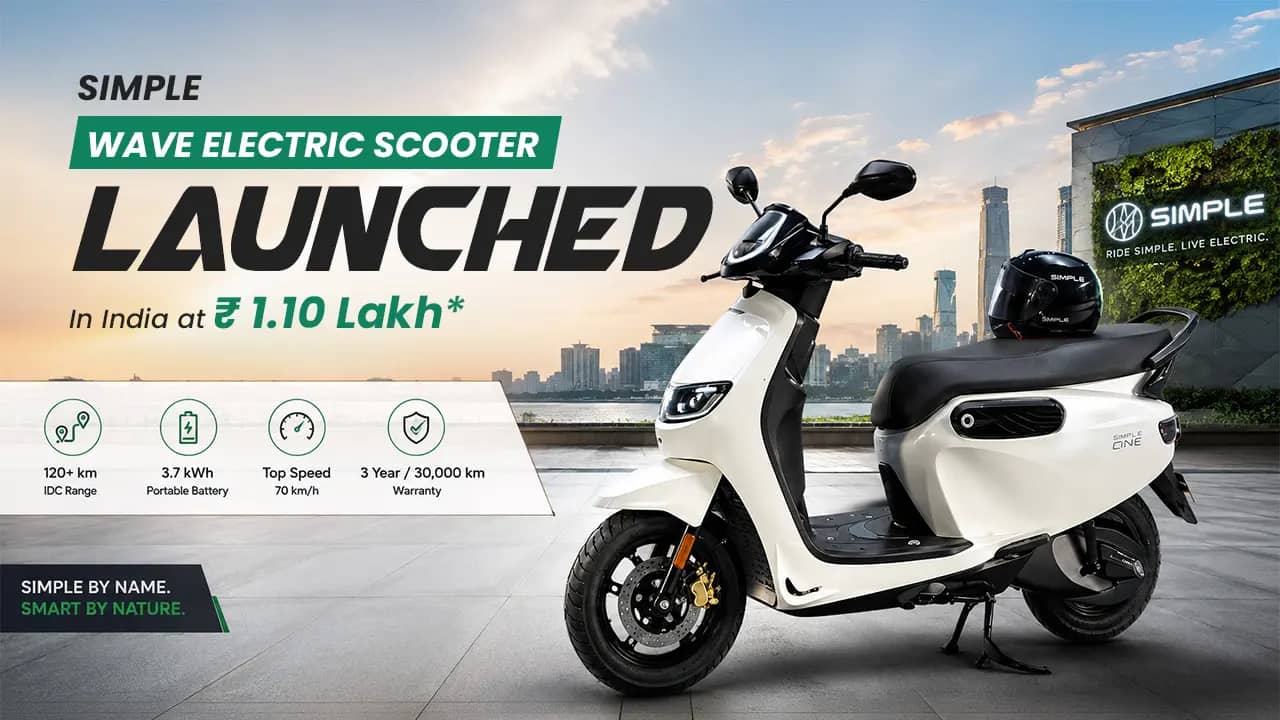
Simple Energy has launched the Wave, its first family-oriented electric scooter, in India at an introductory ex-showroom price of Rs 1,09,999. Deliveries begin September 25 across six variants spread over four battery packs, offering claimed ranges from 110km to 243km. The Wave features a 6.4kW motor, 90km/h top speed, 70-litre underseat storage, and a 920mm seat. It comes with hill hold assist, regenerative braking, and a tip-detection safety cutoff as standard. Positioned against the TVS iQube and Bajaj Chetak, it undercuts both on price while claiming a segment-leading range.
The Simple Wave electric scooter has gone on sale in India at an introductory ex-showroom price of Rs 1,09,999 in Bengaluru, marking Simple Energy's cheapest scooter to date. Deliveries begin on September 25, and the timing matters: this is the brand's first genuine push into family-scooter territory, a segment currently ruled by the TVS iQube and Bajaj Chetak. For anyone in India cross-shopping electric two-wheelers this month, the Wave changes the math because it undercuts most established rivals while claiming a class-leading 243km range on the top variant.
Six Variants, Four Batteries — What Rs 1.10 Lakh Actually Buys
Simple isn't selling one Wave, it's selling six. The line-up splits into three families — Wave S, Wave, and Wave+ — spread across four battery packs: 2.2kWh, 2.7kWh, 3.7kWh, and 5kWh. The base Wave S with the smallest pack claims 110km of IDC range, the 2.7kWh version stretches to 132km, the mid-tier 3.7kWh Wave manages 171km, and the range-topping Wave+ hits 243km on paper. All six run the same 6.4kW motor and top out at 90km/h, so the difference between variants is really about how far you can go before charging, not how fast you go once you're moving. Simple has confirmed pricing only for the base Wave S so far; the company hasn't revealed what the mid and top variants will cost, which is worth keeping in mind if the 243km Wave+ is what actually interests you.
Real-world range on any electric scooter tends to run 15-20 percent below the claimed IDC figure once you factor in Indian traffic, air conditioning-adjacent accessory draw, and pillion weight. So treat that 110km base figure as closer to 90-95km in daily Bengaluru or Delhi traffic, and the 243km flagship as more like 195-205km. That's still enough for most riders to go four to five days between charges on a typical 20-25km daily commute.
Storage, Comfort and the Features That Separate It From the One
Unlike Simple's sportier One and Ultra models, the Wave is built around practicality. It gets a 920mm seat — among the longest fitted to any scooter sold in India — along with a flat floorboard, 775mm seat height, and 175mm ground clearance for rougher city roads. The underseat storage claims 70 litres, supplemented by a 4-litre "Pill" compartment and side pods on the body panels, genuinely useful if you're doing grocery runs or ferrying a helmet and bag daily. Higher variants get a 7-inch TFT display with Bluetooth, GPS, turn-by-turn navigation and OTA updates; the base models make do with a simpler 5-inch EBN screen. Every variant, though, gets hill hold assist, regenerative braking, combined braking, and a tip-detection "Drop Safe" feature that cuts motor power if the scooter falls — not a given at this price point.
How the Simple Wave Price Compares to the TVS iQube and Bajaj Chetak
This is where the Wave earns its shot. The TVS iQube starts closer to Rs 1 lakh depending on variant and state subsidy, while the Bajaj Chetak typically sits in the Rs 1.18-1.21 lakh bracket for comparable range. Hero's Vida VX2 and the newer Ather Konarc also compete in this band. None of them currently offer a 243km claimed range at any price, let alone one that starts under Rs 1.10 lakh.
Range numbers across the segment are all IDC-rated, so none of them will match real-world riding exactly, but the gap between Wave+ and its rivals is wide enough that it should hold up even after the usual real-world haircut.
What the Numbers Look Like on Your Wallet
Financing the base Wave S with a standard 20 percent down payment (roughly Rs 22,000) over 60 months at 11 percent interest works out to an EMI of around Rs 1,900 a month on the remaining Rs 88,000. Compare that against running costs: charging a 2.2kWh pack fully costs somewhere between Rs 15 and Rs 18 at typical Bengaluru domestic tariffs, which works out to roughly Rs 0.15-0.18 per kilometre. A petrol scooter doing 45kmpl at the current Rs 103/litre rate costs about Rs 2.29 per kilometre. Ride 1,000km a month — a realistic figure for a daily commuter — and you're looking at fuel savings of roughly Rs 2,000-2,100 every month over petrol, which more than offsets the EMI on its own. Expect service costs at the 10,000km mark to stay light, likely under Rs 2,000, since there's no engine oil or clutch to replace; brake pads, tyres and the usual electrical check-up are the main line items.
Should You Book One Now
If you want the longest range on offer, wait. Simple hasn't priced the 3.7kWh and 5kWh variants yet, and paying for a scooter without knowing its final cost isn't a great position to be in. But if the base Wave S's 110km range covers your daily distance, the Rs 1,09,999 price tag undercuts the iQube's better-equipped trims and the Chetak outright, while adding storage and safety features neither offers at this price. This isn't a scooter built to chase Ather's performance crowd — it's built for someone who wants a practical, no-drama daily ride with room for actual life to fit under the seat. Check the on-road price and EMI for the Simple Wave in your city on Drivio.
The Simple Wave electric scooter starts at Rs 1,09,999 (ex-showroom, Bengaluru), with pricing for the higher 3.7kWh and 5kWh variants still unannounced. It targets practical, everyday riders rather than performance buyers, with a spacious floorboard, 70-litre storage, and a 7-inch TFT display on top trims. Running costs stay low, with charging costing roughly Rs 0.15-0.18 per km against a petrol scooter's Rs 2.29 per km. Against rivals like the TVS iQube and Bajaj Chetak, the Wave offers stronger range and storage at a competitive starting price.