Kawasaki Ninja 500 India Price Hits Rs 5.76 Lakh With New E20 Update
Overview
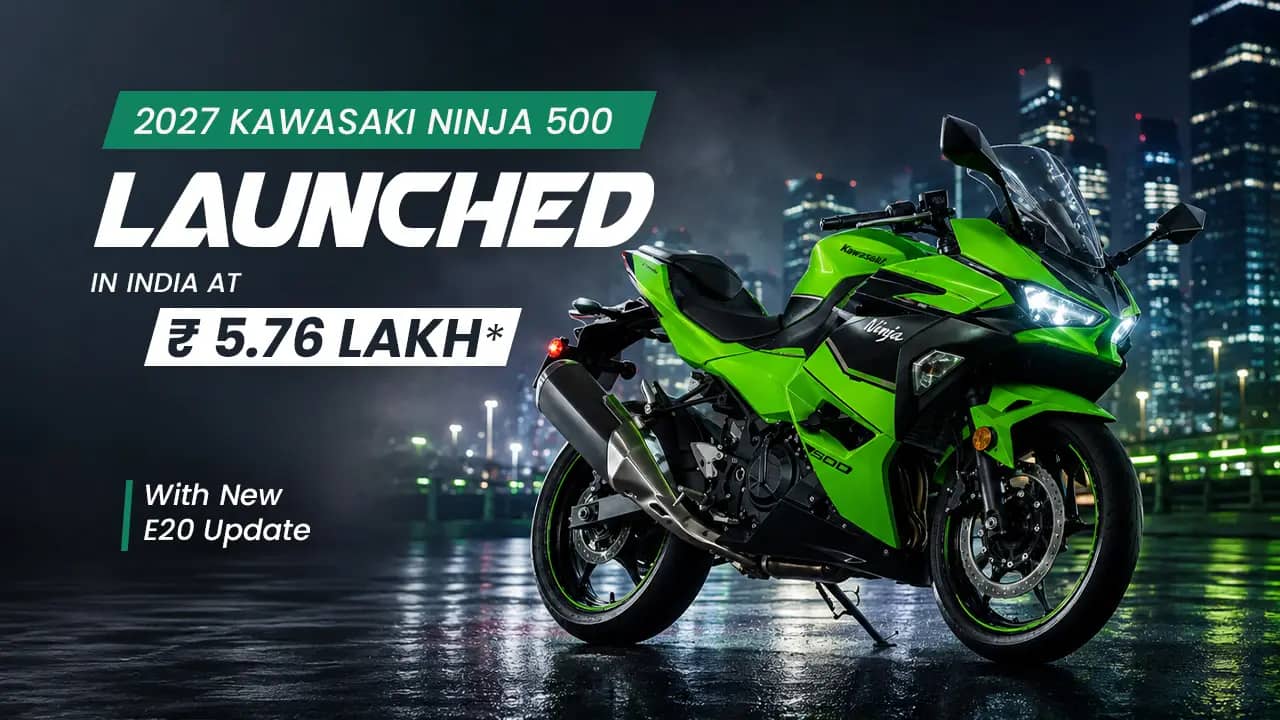
The Kawasaki Ninja 500 gets an E20-compliant update in India, priced at Rs 5.76 lakh (ex-showroom), Rs 10,000 above the outgoing model. The fully-faired sportbike retains its 451cc parallel-twin engine, producing 45 bhp and 42.6 Nm, paired with a 6-speed gearbox and slip-assist clutch. Visually, it now comes exclusively in Kawasaki's signature Lime Green. The update resolves fuel-compliance concerns that had fuelled speculation about the model's exit from India, while mechanical and electronic specifications remain unchanged from the outgoing version, keeping its position in the sub-500cc twin-cylinder segment intact.
The Kawasaki Ninja 500 price in India now stands at Rs 5.76 lakh (ex-showroom), following an update that finally makes the bike compliant with E20 ethanol-blended fuel. That's Rs 10,000 more than before, and it arrives dressed in Kawasaki's signature Lime Green — the same shade the brand uses on its supersport flagships. For a bike that spent the better part of a year facing rumours of a quiet exit from India over fuel-norm compliance, this update is less a facelift and more a survival note.
What Actually Changed in the Kawasaki Ninja 500 India Update
Nothing under the fairing has moved. The 451cc, liquid-cooled, parallel-twin engine still makes 45 bhp at 10,000rpm and 42.6Nm of torque, sent through a 6-speed gearbox with a slip-and-assist clutch. What's changed is fuel tolerance — the engine can now run on petrol blended with up to 20 percent ethanol without the top-end wear issues that plague non-compliant motors on Indian pumps. Kawasaki hasn't touched the steel trellis frame, the 17-inch wheels wrapped in Dunlop Sportmax rubber, or the 310mm front disc and 220mm rear disc setup. The instrument cluster stays basic — no traction control, no riding modes, nothing you'd call rider aid beyond ABS. This is a spec sheet frozen in time, given a new fuel certificate and a paint job.
That matters more than it sounds. Bikes stuck outside E20 compliance have quietly disappeared from Indian price lists over the past two years, and Kawasaki choosing to re-certify rather than discontinue tells you the company still sees a market here, even a small one.
Kawasaki Ninja 500 On-Road Price and What the EMI Looks Like
Ex-showroom Rs 5.76 lakh in Delhi translates to an on-road price that typically lands somewhere past Rs 6.6 lakh once you factor in RTO registration and comprehensive insurance for a 500cc import — CBU units attract steeper road tax slabs than locally assembled bikes, so budget accordingly rather than going by the showroom sticker alone. Financing it the standard way — 20 percent down payment, a 60-month tenure at 11 percent interest — brings the loan principal to roughly Rs 4.6 lakh, working out to an EMI near Rs 10,000 a month. That's a real number worth sitting with, because it's higher than what most riders pay for an entire used hatchback's EMI, for a bike that still runs a basic LCD dash.
Running costs don't do the Ninja 500 many favours either. Real-world mileage sits around 25-26 kmpl, which at today's Delhi petrol price of roughly Rs 103 a litre works out to about Rs 4 per kilometre. Ride it 1,200km in a month — a realistic figure for someone using it as a weekend and occasional-commute bike rather than a daily grinder — and you're looking at close to Rs 4,850 in fuel alone. Add servicing: as a CBU import, parts and labour at authorised Kawasaki service centres typically run higher than what owners of India-assembled 500cc twins pay, so expect periodic service visits to cost more than the segment average, even if Kawasaki hasn't published exact figures for the E20 variant.
Kawasaki Ninja 500 vs Aprilia RS 457: The Real Comparison
The Ninja 500's most direct rival remains the Aprilia RS 457, priced at Rs 4.22 lakh ex-showroom — a full Rs 1.54 lakh cheaper. Drivio has already run the two head-to-head in an earlier RS 457 vs Ninja 500 comparison, and the gap in equipment hasn't closed since. The RS 457 runs a 270-degree crank for a raspier exhaust note, gets ride-by-wire throttle, traction control, and multiple riding modes — none of which the Ninja 500 offers. Aprilia's aluminium twin-spar frame also gives it sharper cornering manners than Kawasaki's steel trellis setup, even though the two bikes are within 4kg of each other on the scale.
Where the Ninja claws some of it back is in outright usability: a lower seat height, a larger fuel tank, and a cable-throttle simplicity that some riders genuinely prefer over ride-by-wire fussiness. It's the more relaxed, less try-hard bike of the two.
Should You Buy the Kawasaki Ninja 500 in India Right Now
If you've been riding a KTM 390 Duke or a Triumph Speed 400 and want a step into fully-faired territory, the Ninja 500 gives you Kawasaki badge value and a genuinely smooth, refined engine — that part isn't in question. But at Rs 5.76 lakh, you're paying a straight premium over the RS 457 for less kit, and that premium is the entire decision. Buyers chasing outright value and modern electronics should look hard at the Aprilia first. Buyers who want the simplest, most unbothered ownership experience in this class, and who've always wanted a Ninja badge on their garage wall, won't be talked out of it by a spec sheet.
Check the on-road price and EMI for the Kawasaki Ninja 500 in your city on Drivio.
Kawasaki has re-certified the Ninja 500 for Indian roads with E20 fuel compatibility, priced at Rs 5.76 lakh ex-showroom. On-road costs in Delhi push past Rs 6.6 lakh, with EMIs near Rs 10,000 monthly on standard financing terms. It rivals the Aprilia RS 457, which undercuts it by over Rs 1.5 lakh while offering richer electronics and a lighter frame. The Ninja counters with a lower seat height, larger tank, and simpler ownership experience. Buyers should weigh Kawasaki's badge value and refinement against the RS 457's stronger value proposition before deciding.