Honda Shine 125: Price, Mileage and Features Explained for Indian Buyers
Overview
Looking for a dependable 125cc commuter in India? This guide covers what the Honda Shine 125 costs in Delhi, how much petrol it really drinks each month, and what a loan EMI looks like. We also line it up against the SP 125 and Pulsar 125. Ex-showroom prices start near ₹83,400, so the arithmetic matters.
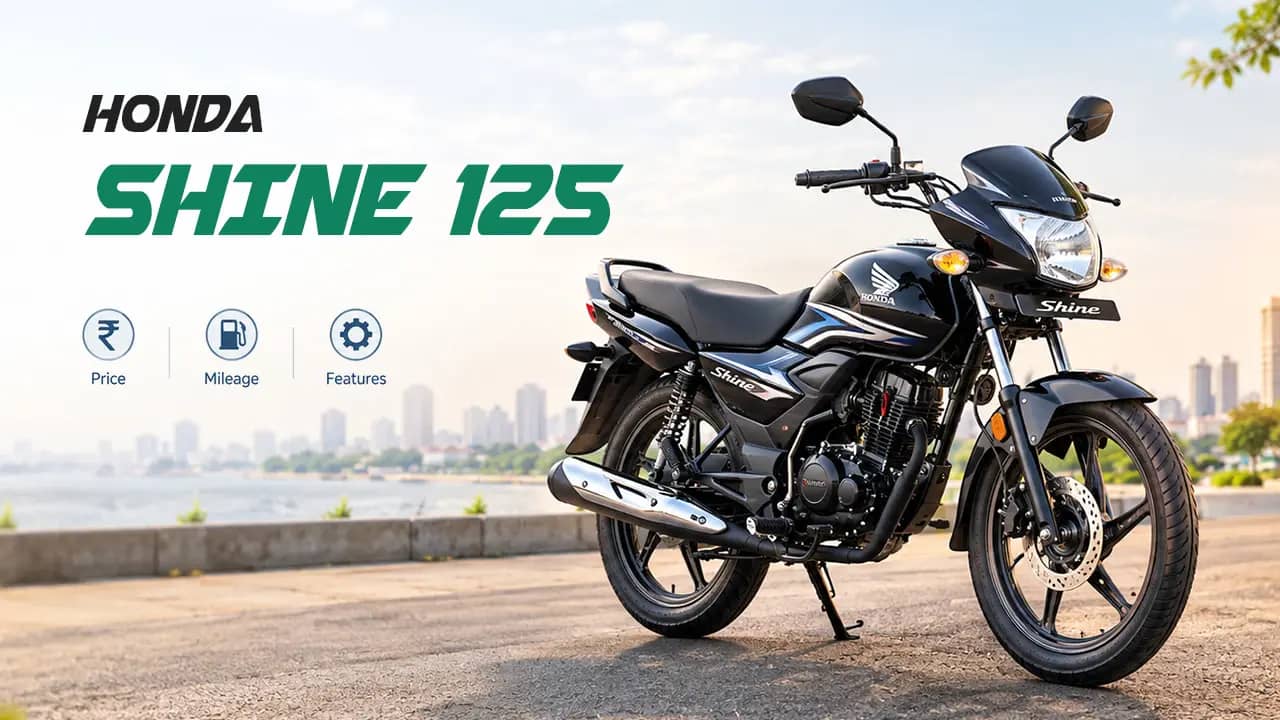
The Honda Shine 125 starts at around ₹83,400 ex-showroom in Delhi, and it was India’s best-selling 125cc motorcycle in April 2026. Honda raised prices by up to ₹1,072 in June, so the sticker is firmer than it was in January. With festive-season offers now rolling out, the question is whether the Shine deserves roughly ₹96,000 of your money or whether a rival does.
Honda Shine 125 on-road price in Delhi, and what a loan really costs
Ex-showroom, the drum variant sits near ₹83,400. The disc is likely around ₹87,300, though that figure predates the June revision. Add about ₹6,700 for road tax and registration and roughly ₹6,100 for comprehensive insurance, and the Delhi on-road price of the drum lands near ₹96,200. The disc and Limited Edition both cross ₹1 lakh on the road.
Most buyers here finance, so run the numbers. Put ₹10,000 down on the drum and you borrow about ₹86,200. Over 36 months at 11%, the EMI is close to ₹2,820 and you pay roughly ₹15,300 in interest. At 14%, which some lenders charge on two-wheeler loans, it climbs to about ₹2,950. That ₹130 monthly gap is why you should check your loan offer before you walk into the showroom, not after.
Engine, features and the way it rides
Under the tank is a 123.94cc single-cylinder PGM-FI engine, now OBD2B-compliant. It makes 10.59 bhp (about 10.7 PS) at 7,500 rpm and 11 Nm at 6,000 rpm. That looks modest next to the Pulsar 125’s 11.64 bhp, and it is. But nobody buys a Shine to win a traffic-light sprint. Owners consistently describe the motor as refined at city speeds, and the five-speed gearbox shifts without drama.
The Honda Shine 125 also gets a fully digital cluster with a real-time mileage readout and distance-to-empty, plus a USB Type-C charging port. Both are genuinely useful if you commute with a phone on navigation. The bike weighs just 113-114 kg with a 791 mm seat, so it is easy to wheel out of a tight parking spot or hold up at a crowded junction. Honda also offers an extended warranty of up to ten years, and that matters when you plan to keep the bike for a decade.
Real-world mileage and your monthly petrol bill
ARAI rates the Shine at around 55 kmpl. Owners report 48-55 kmpl in mixed riding, and heavy stop-go traffic drags that to 45-48. Those are the figures to plan around, not the brochure.
At ₹103 a litre and 1,000 km a month, the bill works out like this. At 55 kmpl you burn 18.2 litres and spend about ₹1,870. At 50 kmpl it is 20 litres and ₹2,060. In crawling Delhi or Mumbai traffic at 46 kmpl, you use 21.7 litres and pay about ₹2,240. A full 10.5-litre tank costs roughly ₹1,080 and covers around 525 km at 50 kmpl, so most commuters fill up once every two weeks.
What the first 10,000 km likely cost to maintain
Expect roughly ₹3,500 to ₹4,500 across the first 10,000 km at an authorised dealer, covering paid services and an oil change. Labour rates differ by city, so treat that as likely rather than fixed. Honda’s simple air-cooled engine rarely throws surprises, which is a big reason resale values stay strong.
Shine vs SP 125 vs Pulsar 125: where the money goes
The SP 125 is the Shine’s closest sibling and the obvious cross-shop. It costs about ₹5,100 more, uses the same 124cc engine and carries a slightly bigger 11-litre tank. Assume it does 58 kmpl against the Shine’s 52 in your hands. That saves about ₹200 a month on petrol, so the premium pays itself back in roughly two years and a bit. If you keep your bikes longer than that, the SP is the smarter spend.
The Pulsar 125 plays a different game. It is faster, sportier and thirstier, and it suits younger riders who prefer attitude to thrift. TVS’s Raider 125 undercuts everyone at around ₹82,900, but the Shine’s resale record and Honda’s service network are hard to beat in smaller towns. If frugality is all you need, the Hero Splendor Plus Xtec at around ₹81,000 is cheaper to run, though its 97cc engine feels strained once you add a pillion.
The verdict: who should buy it
Buy the drum variant if you ride mostly in the city, cover under 1,200 km a month and want a bike that never makes demands. The disc’s extra ₹4,000 is worth paying only if you regularly ride on highways or carry a pillion and luggage. The Limited Edition is cosmetic, so skip it.
Pick the SP 125 if you plan to hold the bike for four years or more. Pick the Pulsar 125 only if power matters more than petrol. For everyone else, the Shine is the safe, sensible, resale-friendly choice, and it has been for years. Whichever way you lean, the sums change from city to city, so check the on-road price and EMI for the Honda Shine 125 in your city on Drivio before you book.
Buy the Shine if you want a low-fuss, easy-to-resell bike and ride under 1,200 km a month. Budget about ₹2,000 a month in petrol at 1,000 km. Riders chasing every last kmpl should look at the SP 125, and anyone who wants punch over thrift can test the Pulsar 125. For most families, the drum variant is the sensible pick.