Festive Bike Booking: What to Ask Before Paying a Token in India
Overview
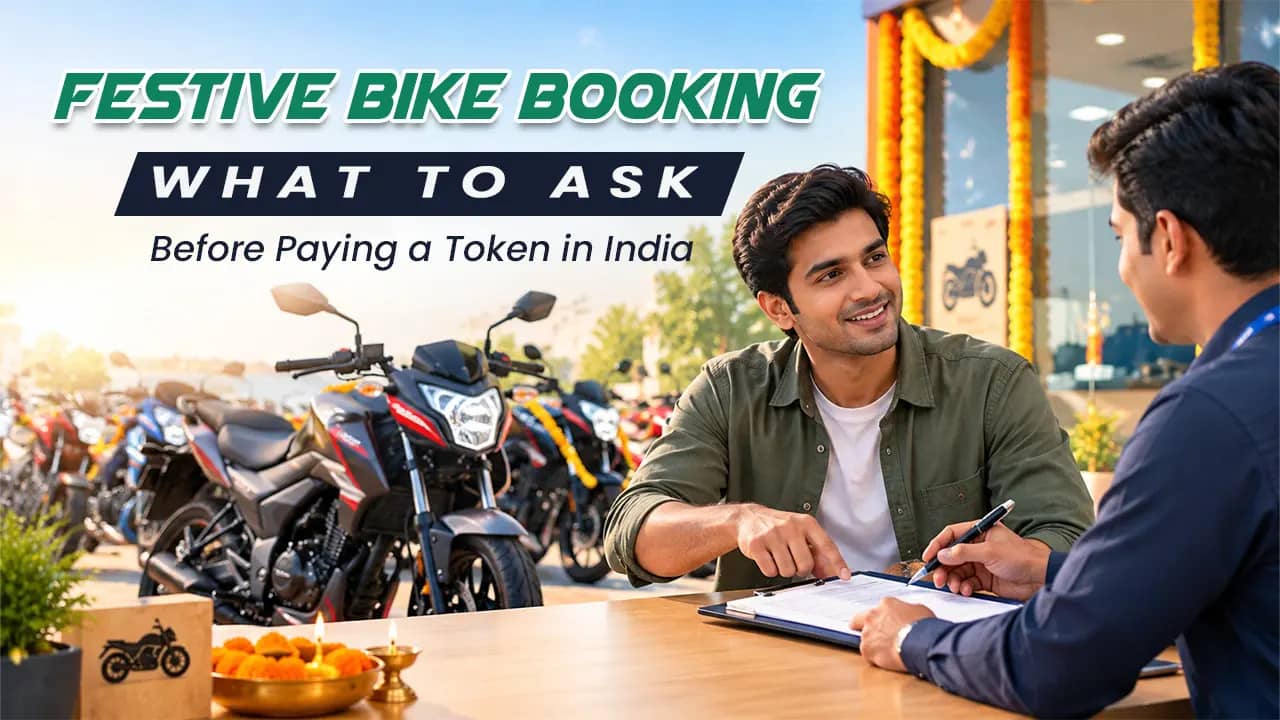
Diwali is weeks away, and dealers across India are collecting booking tokens now. This guide uses a Honda Shine 125, around ₹80,000 ex-showroom in Delhi, to show what a token actually commits you to. It covers the on-road price, refund terms, loan EMI and delivery questions that decide whether a festive offer saves you money. It is written for first-time buyers and anyone upgrading from a 100cc commuter.
Festive bike booking in India rewards the buyer who asks for numbers in writing: a Honda Shine 125 at around ₹80,000 ex-showroom in Delhi will likely cost closer to ₹92,000 on-road, and that ₹12,000 gap is where most token-stage surprises hide. Diwali falls in early November this year, which means showrooms are at their loudest right now, with “limited stock” boards and offers that expire on Sunday. A token of ₹1,000 to ₹5,000 feels harmless. It rarely is, because it often locks you to a dealer, a variant and sometimes an insurance partner before you have seen a single rupee of the final bill.
What is the real on-road price of a bike in Delhi?
The ex-showroom figure is a headline, not a bill. For a bike in the ₹80,000 range, Delhi’s road tax is likely around 4 per cent, roughly ₹3,200. Registration and smart-card charges add about ₹1,000. The big one is insurance: the mandatory long-term third-party cover plus one year of own-damage cover usually lands between ₹6,000 and ₹7,500 on a 125cc bike. Dealer handling charges and “RTO assistance” fees come on top, and these are the lines worth questioning.
Ask for a printed breakup, line by line, before you hand over anything. Mumbai buyers should expect a higher road tax slab and an on-road figure that runs a few thousand rupees above Delhi’s. If the salesperson says “we’ll finalise at delivery,” treat that as a no.
Is the token amount refundable?
It depends on who you pay and how. Tokens paid on a manufacturer’s own booking portal usually come with a stated cancellation window. Money handed over at the showroom counter follows whatever the dealer decides, and a verbal promise of “full refund anytime” is worth nothing once you are standing at the cashier’s window with a dispute.
Three questions settle it. Is the token refundable in full, and within how many days? Does the receipt name the exact variant, colour and ex-showroom price? And will the price be locked at booking, or does it move to whatever applies on delivery day? That last one matters more than it sounds. GST was cut on bikes up to 350cc last September, and buyers who booked before the change saw prices shift between booking and billing. Get the receipt on dealership letterhead, with a name and a signature.
Festive bike booking and the finance trap
Dealers love to bundle the loan with the token. The pitch is “zero down payment” or “EMI from ₹1,999,” and both are true in the way a car park sign saying “free” is true until you read the rate card.
What a ₹75,000 loan really costs
Take the Shine 125 at about ₹92,000 on-road with a ₹17,000 down payment. That leaves a loan of roughly ₹75,000. At 11 per cent over 36 months, the EMI is about ₹2,455, and you repay around ₹88,400, so ₹13,400 goes to interest. Accept a dealer-arranged rate of 14 per cent and the EMI rises to about ₹2,563. That is ₹108 more every month, or nearly ₹3,900 across the tenure. Add a 1 to 2 per cent processing fee and the “festive discount” of ₹2,000 is gone.
Ask for the rate, the processing fee, the foreclosure charge and the exact loan amount before you pay a token against a finance scheme. Then get one bank quote independently. It takes ten minutes on a phone and it changes the conversation at the counter.
If you are weighing the two, our earlier coverage of both bikes goes deeper. The short version: the Splendor+ is cheaper to buy and a touch lighter on fuel, while the Shine feels less strained above 60 km/h and is the one I would pick for a highway-adjacent commute.
Stock, delivery date and the manufacturing-year question
Festive demand is when old stock moves. Ask for the manufacturing month and year of the exact unit you are booking, and ask whether it is in the yard or “in transit.” A bike built in early 2026 still carries a full warranty, but you are entitled to know, and you can negotiate on it. A dealer who cannot name a delivery date is telling you the real wait is longer than the one on the poster.
This is also where a festive bike booking can go wrong in a quiet way. You pay the token in October, the preferred colour is out of stock, and the dealer offers whatever is available “so you can ride home for Diwali.” Decline politely and ask for a refund instead. A bike you accepted under pressure is a bike you own for years.
Look hard at free accessories as well. A helmet and floor mat are fine. A “mandatory” accessory kit of ₹4,000 that you did not choose is a price increase with a gift ribbon on it. Exchange offers deserve the same scrutiny: get the old bike’s valuation written down separately from the new bike’s discount, because dealers love to blend the two.
What the bike will cost to live with
Do the running-cost sum before you sign, not after. A Shine 125 returns around 55 kmpl in mixed city riding. At 1,000 km a month that is about 18 litres of petrol, and at roughly ₹103 a litre the fuel bill comes to ₹1,870 a month. Scheduled services at an authorised centre typically run a few hundred rupees plus engine oil, so budget about ₹700 to ₹1,000 per visit, with the 10,000 km service tending to cost a little more because of the extra checks.
Add the EMI and a rider is looking at roughly ₹4,400 to ₹4,500 a month for the first three years. That number, not the festive banner, is the one to compare with your salary.
The verdict
Book only after you hold three documents: a written on-road breakup, a refund clause on the token receipt, and an independent loan quote. If the dealer resists any of the three, the offer is not as good as it looks, and another showroom three kilometres away will happily provide them. Buyers settling on a commuter should book a named, in-stock unit. Anyone waiting for a specific colour should use a refundable online booking, since a festive bike booking made on a handshake leaves you with no leverage.
Check the on-road price and EMI for the Honda Shine 125 in your city on Drivio, then walk into the showroom with the numbers already in your pocket.
Pay no token until the dealer writes down the full on-road figure and the refund terms. On a Shine 125, a 3-point difference in loan interest costs about ₹3,900 over 36 months, so compare bank quotes before accepting the dealer’s. Running costs sit near ₹1,900 a month at 1,000 km. Commuter buyers should book only against a named, in-stock unit. Anyone chasing a waiting-list colour should insist on a refundable online booking.