Overview
This article covers the Ather 450X’s claimed real-world range, the factors that move it, and a transparent charging-cost formula built on usable battery capacity and 85% charging efficiency. It tabulates monthly electricity spend for six daily distances, adds insurance and EMI to show the monthly cost of ownership, and compares cost per kilometre with three rivals. It then suggests how Drivio’s comparator can handle electric scooters, gives practical range tips, and ends with a verdict on who should buy.
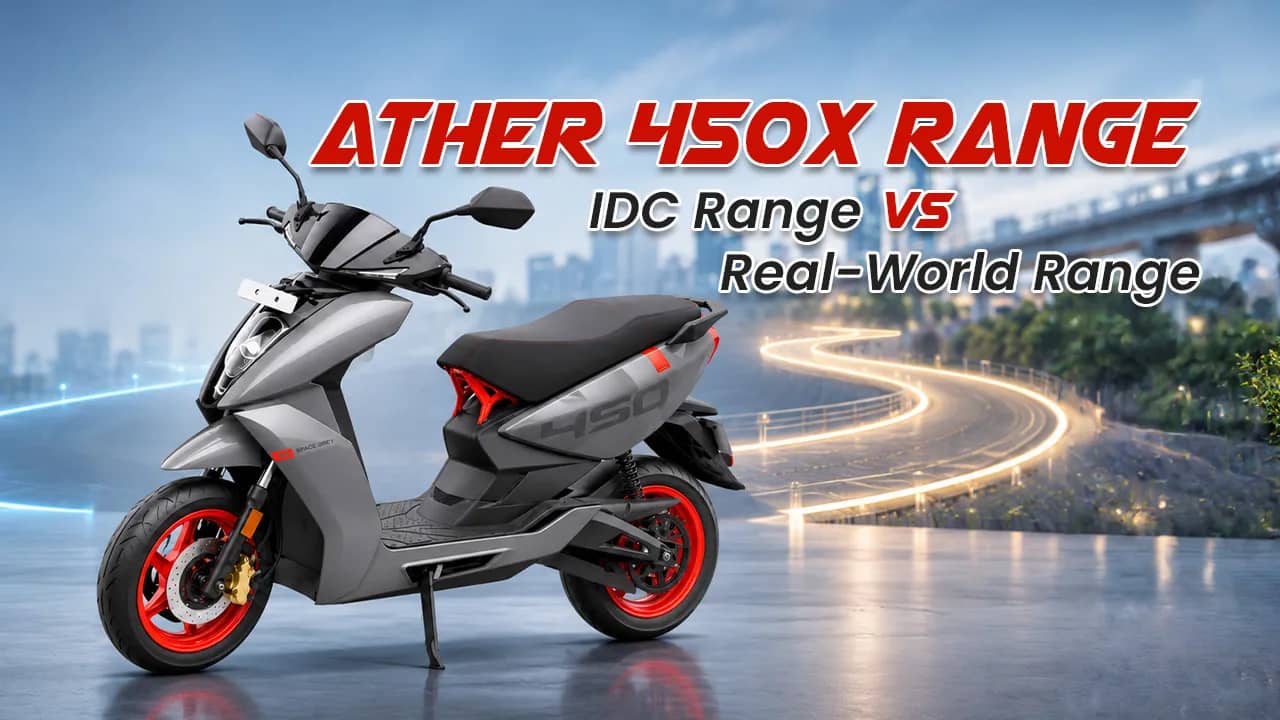
The Ather 450X typically delivers about 85–110 km on a full charge in real-world riding, against a claimed IDC range of 105 km. Gentle riding in Eco or Smart Eco sits at the upper end, while Warp mode is rated at just 65 km. Below, we compare the claimed and real figures, then calculate what each kilometre costs.
Claimed IDC range vs real-world range
IDC range comes from a standardised test cycle, not from traffic, gradients and sustained speed. Drivio lists the 450X’s IDC range at 105 km, with a 3.7 kWh battery (3.24 kWh usable) and a top speed of 90 km/h on the display (80 km/h actual). Real-world range falls with higher speeds, heavier riders, hills, heat, low tyre pressure and sportier modes. Drivio’s own pros-and-cons list also names real-world range as a limitation. No separate independent-test or owner-survey figures are used here, so 85–110 km is the working band.
City, highway, interstate and mixed range
Only one real-world band is published, so we do not invent separate figures:
City and mixed use: about 85–110 km, depending on mode and traffic.
Performance riding: Warp mode is rated at 65 km.
Highway: no tested figure is available. Sustained speeds near the 80 km/h actual top speed draw more energy than city riding.
Interstate touring: no range figure is available. Charging takes 4 hours 30 minutes for 0–80% and 5 hours 40 minutes for 0–100%, so long trips need planned stops.
Monthly charging cost for 10–100 km a day
Method: usable battery of 3.24 kWh ÷ 85% charging efficiency = 3.81 kWh drawn from the wall per full charge. Dividing by a conservative 85 km range gives 0.045 kWh/km. Multiply by the tariff, then by monthly distance (30 days).
Tariffs used (Delhi, 2026):
₹4.5/kWh on a dedicated EV connection, excluding taxes.
About ₹8/kWh for households in higher domestic slabs. Domestic slabs start at ₹3/kWh for the first 200 units.
₹10/kWh at the low end of public AC charging, which runs ₹10–15.
DC fast charging runs ₹18–24/kWh.
Rates in other cities and states differ by distributor, so they are not extended here.
That works out to ₹0.20, ₹0.36 and ₹0.45 per km respectively. A rider achieving 110 km pays about 23% less. At 100 km a day you exceed one charge, so budget for a mid-day top-up.
Complete monthly ownership cost
Shown for 30 km a day at ₹8/kWh. Insurance and EMI follow Drivio’s price and EMI pages (EMI, running cost).
Insurance is the first-year premium, which will change at renewal. Battery warranty and replacement costs are not available, so none are quoted.
How it compares with rivals
Cost per km uses nominal battery capacity, 85% efficiency and ₹8/kWh. Claimed figures vary by variant and test basis, so lean on the real-world column.
At 30 km a day (10,950 km a year), the Ola is roughly ₹500–1,900 cheaper to charge annually. Against the iQube ST, the 450X ranges from about ₹150 cheaper to ₹870 dearer, which is effectively level. No petrol price or scooter mileage was supplied, so no petrol saving is quoted. The formula is (petrol cost per km − charging cost per km) × annual km. See our Ola S1 Pro and Bajaj Chetak comparisons.
Adapting Drivio’s mileage comparator
The fuel cost calculator could swap km/litre and fuel price for usable kWh, real-world range, efficiency and tariff. Useful additions:
A city/state tariff selector with manual override.
A home versus public charging toggle.
Side-by-side electric and petrol results, with annual savings.
Optional insurance, maintenance and EMI fields linked to the EMI calculator.
Tips to improve range and charging
Use Eco or Smart Eco for routine commutes and save Warp for when you need it.
Accelerate and brake smoothly.
Keep tyres at the recommended pressure and avoid unnecessary load.
Prefer home or dedicated-tariff charging, since public DC costs several times more per unit.
Avoid regularly running the battery empty, and park in shade in hot weather.
Who should buy the Ather 450X?
The 450X suits urban commuters covering up to about 60–80 km a day who can charge at home or on an EV tariff. Its charging cost of ₹0.20–0.45/km is low, but the EMI dominates monthly spend. Riders wanting the longest real-world range may prefer the Ola S1 Pro, while the iQube ST is near-equal on cost per km. Compare options on Drivio’s compare page, check reviews, or explore finance offers.
The Ather 450X has a claimed IDC range of 105 km, while riders can typically expect about 85–110 km on a full charge. This guide explains why the figures differ and calculates charging costs for 10 to 100 km of daily riding at Delhi tariffs. It adds insurance and EMI for a monthly ownership picture and compares the scooter with the Ola S1 Pro, TVS iQube ST and Bajaj Chetak, so you can judge whether it suits your commute.